
“The books say this shipment had a 30% gross margin. So why, when we close the year, did the company make nowhere near that?” Owners of import trading companies ask this a lot at year end. Dig in and you usually find the same thing: the cost sales used for quotations was the unit price on the supplier invoice times the exchange rate. Ocean freight, customs brokerage fees, warehouse rent and inland trucking were booked to expense accounts and hit the P&L together at month end.
I'm Johnny Yang, founder of Brightstream Technology in Taiwan. I've led a team building systems for seven years, handled more than 252 projects across 32+ industries, and trading companies, distributors and agents are a group I run into often. With these companies, eight times out of ten the system problem ends up back at one question: how is cost actually calculated.
The answer: getting landed cost into your system comes down to three things. First, hang every cost for one import shipment — goods value, international freight, insurance, duties, customs brokerage and storage charges, inland transport — under a single “import batch,” instead of booking each one as its own expense. Second, allocate those costs to each item on a sensible basis: space-related costs like freight by volume or weight, value-related costs like insurance by amount, and duties straight to the item. Third, late bills are normal, so receive stock at an estimated cost first, adjust once all the bills are in, and push the difference back onto that batch's cost. If you use invoice unit price times exchange rate as your cost, gross margin will be overstated, and the items overstated most are usually the big, cheap ones.
Why using invoice price as cost makes sense, and why it is dangerous
Let me take your side first. When goods hit the warehouse, the only number you know for sure is the supplier invoice. The freight bill may not arrive until next month, the customs broker's invoice takes time too, but sales has to quote today and the warehouse has to receive today. Plugging in the invoice price for now is a practical move.
And at the company level, the books are not wrong. Freight and brokerage fees are recorded, just as expenses. The year-end total on the P&L is correct.
The real problem is at the item level. These costs never make it back onto item cost, so every product's margin is calculated off a cost that is too low. The report makes every item look profitable, but you can't tell which ones are actually being subsidized by someone else's profit. Sales quotes off this cost. Managers use this margin to decide whether to cut prices for a promotion. That means making decisions every day off the wrong map.
This is the same kind of problem as the three cost blind spots that keep your quotation margins wrong. For import trading companies, the blind spot is mostly hiding in freight and duties.
What does landed cost include, and when do you know the amounts?
Landed cost, put simply, is all the money spent on a shipment from the moment it leaves the supplier until it is in your warehouse and ready to sell. The most annoying thing about these costs is that each amount shows up at a different time.
| Cost item | When you know the amount | Common allocation basis | Part of inventory cost? |
|---|---|---|---|
| Goods value (supplier invoice) | At shipment | Directly to item | Yes |
| International freight | Around arrival at port; bill often late | Volume or weight | Yes |
| Insurance | When the policy is bought | By goods value | Yes |
| Import duties | At customs clearance | Directly by each item's tariff classification | Yes |
| Brokerage fees, warehouse rent, terminal charges | Billed in stages after clearance | Amount or piece count | Usually yes |
| Inland transport to your own warehouse | After arrival at warehouse | Volume or weight | Yes |
| Import business tax (Taiwan's VAT) | At customs declaration | Not allocated | Usually no, if creditable |
| FX difference at payment | Only known at payment | Not allocated | Usually booked as FX gain/loss |
I flagged the last two rows because many companies stuff them into cost too. Creditable import business tax is input tax, and exchange differences mostly go to FX gain or loss. Neither usually goes into inventory cost. How you actually handle them should follow your accountant and your company's accounting policy. The system just needs to follow the settings.
One more thing worth knowing: the duty base is not just the goods value. According to Taiwan Customs, freight and insurance up to the port of import are included in the dutiable value (Keelung Customs, Customs Administration, Ministry of Finance: Correctly declaring the dutiable value of imported goods). In other words, freight is not just a cost. It also changes your duties. That is why freight has to follow its batch and can't be treated as just this month's expense.
How to choose an allocation basis: a hypothetical full container, worked through
Once costs are attached to the batch, the next step is splitting them across items. Pick the wrong basis here and the results swing a lot. Here is a hypothetical example.
Say one container holds two products. A is a small appliance, 500 units at NT$1,000 each, NT$500,000 total. B is a storage box, 2,000 units at NT$50 each, NT$100,000 total. International freight, brokerage charges and inland transport for this container add up to NT$60,000. To keep the math simple, ignore duties for now.
Allocate by value: A is five-sixths of the goods value and gets NT$50,000, or NT$100 more per unit, for a cost of NT$1,000 + 100 = NT$1,100. B gets NT$10,000, NT$5 more each, for a cost of NT$55.
Allocate by volume: The storage boxes are big and light; say they take up three-quarters of the container. A gets NT$15,000, NT$30 more per unit, for a cost of NT$1,030. B gets NT$45,000, NT$22.5 more each, for a cost of NT$72.5.
Now say B sells for NT$80. By value, gross margin is about 31% and it looks like a good business. By volume, gross margin is only about 9%. Same container, same freight bill, different allocation method, and this item goes from “core product” to “barely breaking even.”
Which is closer to reality? Freight is mostly about space and weight. The storage boxes take up most of the container, so they should carry more of the freight. Allocating by value means the small appliances are paying the storage boxes' freight. So the reps selling B keep thinking it sells well and has great margins, when it is actually being subsidized by A.
That is what I meant: the items overstated most are usually the big, cheap ones.
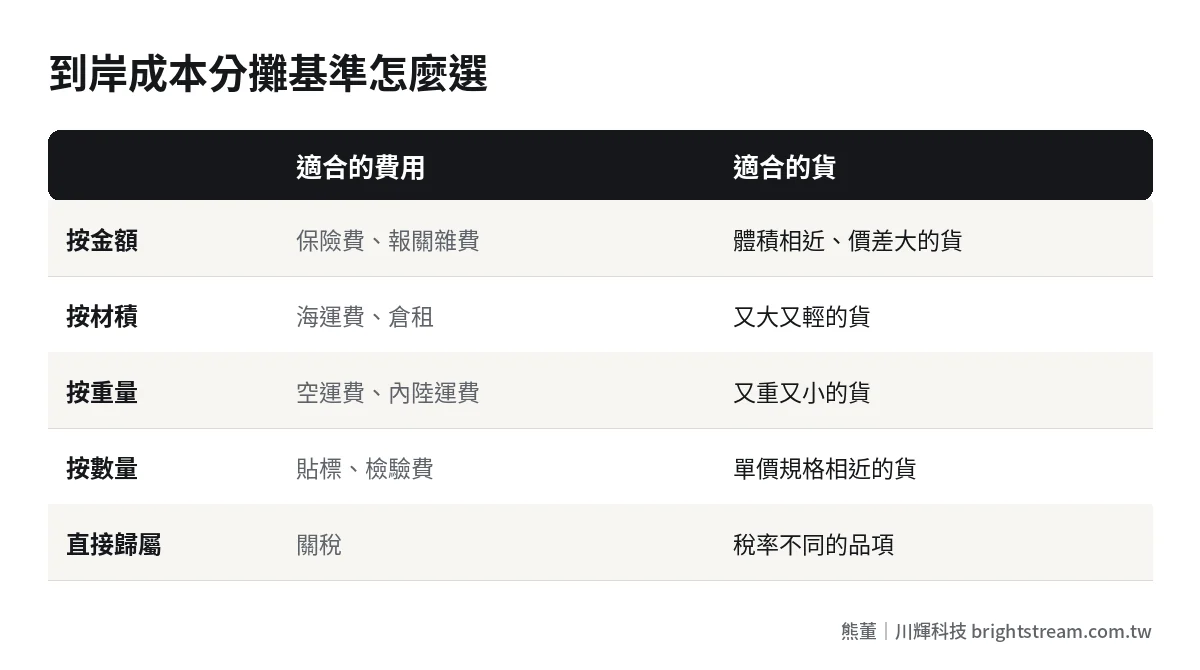
In practice, you don't need one basis for every cost. Insurance relates to value, so allocate by amount. Freight relates to space, so allocate by volume or chargeable weight. Duty rates differ by item, so assign directly. Per-piece work like labeling and inspection goes by quantity. The system has to let different costs use different bases, not force one basis for the whole batch.
What if bills arrive late? Receive at an estimate, adjust when everything is in
The most practical problem with landed cost is timing. The goods are already received, maybe partly sold, and then the freight bill shows up. What do you do?
Use two stages. At receipt, use an estimated cost: goods value times the exchange rate at the time, plus an estimated cost percentage. You don't have to guess the percentage. Back it out from actual costs on the last few batches on the same route from the same supplier. Once you have a system, this percentage updates with every batch and gets more accurate the more you use it.
As the bills come in, the system attaches actual costs back to that batch, reallocates, and calculates the difference between estimate and actual. How the difference is handled: for stock still in the warehouse, adjust inventory cost; for stock already sold, adjust cost of goods sold. That way, once all the bills are in, the margin on your reports goes back to the correct number.
The owner has to make one call here: how long before a batch is closed out. I recommend giving every batch a “closed” status, and only closing it once all costs are in and confirmed nothing is missing. Batches not yet closed should be flagged on reports, so whoever reads the numbers knows that margin is still an estimate.

Once landed cost is right, which owner decisions change?
A lot of owners ask: what's the point of calculating this finely? My answer is that it directly changes three kinds of decisions you make every month.
First, the floor on quotations. If sales sees the real landed cost before cutting a price, they know below which price they're losing money. Where you thought there was 30% of room to give, there may only be 10% once you run the numbers.
Second, who to buy from and how to ship. Two suppliers quote close prices, one ex-works, one delivered to port. On the surface they are hard to compare. Convert both to landed cost and you see which one is actually cheaper. Shared container or full container, sea or air: same logic. Compare total cost when the goods reach your warehouse, not the unit price on the quote.
Third, which products to push and which to buy less of. Once you know which items are actually being subsidized, your list of core products may need reshuffling. That hits company profit more directly than any promotion.
These three decisions used to run mostly on the owner's gut. Gut isn't always wrong, but with lots of SKUs and several containers a month, gut can't keep up.
What does your system need to do to calculate real landed cost?
If you're evaluating a system, or want to know whether your current one is good enough, check it against this list:
- The import batch is its own unit: one batch per bill of lading or container, with every cost document attachable to it, not just recordable in an accounting account.
- The item master has weight, volume and tariff code: without these fields, you can only allocate by value. This step most often gets stuck on incomplete master data.
- Different costs can use different allocation bases: freight by volume, insurance by value, duties assigned directly, all mixed within one batch.
- The estimate-vs-actual difference is calculated and written back automatically: inventory adjusted for stock on hand, COGS adjusted for stock sold, without accounting posting manual journal entries every month.
- Quotations show landed cost: the screen sales uses to quote should show the landed cost from the latest batch, not the invoice unit price.
- The exchange rate used at every step is recorded: order, customs declaration and payment each have a rate, and the system has to record which one each entry used.
I've covered the full picture of what trading companies need from a system, like quotations, import/export documents and multi-currency, in what kind of ERP a trading company needs. For managing multiple price lists, warehouses and currencies, see systems for agents and distributors. This post only digs into cost, because it's the piece most companies get wrong and the one that most affects decisions.
Once landed cost is right, there's a next step: the same item costs different amounts in different batches, so which cost do you use when it ships? That's the inventory costing method question, which I covered in if inventory cost is wrong, your margin is fake. Think about the two together, or the margin still won't be real.
Three things to do before you change systems
Not every company needs to change systems right away. Before that, three things can be done in Excel:
- Build one landed cost sheet per container: collect every cost bill for that container, allocate to items as described above, and calculate each item's actual landed cost.
- Go back over the last three containers: compare actual landed cost to the cost sales has been quoting with, and see how far apart they are. The items with the biggest gaps are the ones whose prices you most need to revisit.
- Find the subsidized products: look especially at bulky, low-price goods. If their actual margin is far below what the report says, decide whether to raise the price, change the packaging, or buy less.
What most often gets stuck here is “we can't get all the bills.” The freight bill goes to purchasing, brokerage fees go to accounting, and the warehouse reconciles inland freight. Everyone holds only part of it. So assigning one person to collect every document for every container matters more than any spreadsheet.
After these three, you'll know clearly how much landed cost affects your company. If the impact is small, Excel is enough. If it's large and several containers come in every month, it's worth having a system do it. The biggest problem with the Excel version isn't that it can't calculate. It's that someone has to remember to do it for every container, and when things get busy, nobody does.
FAQ
Is landed cost the same as CIF?
No. CIF is a trade term meaning the supplier's price already includes freight and insurance to the destination port. Landed cost is something your company calculates itself: the full cost until goods are in your warehouse and ready to sell, which also adds duties, brokerage charges, inland transport and so on. Using the CIF price as cost still understates it.
Should import business tax go into product cost?
If your company can credit input tax, import business tax usually doesn't go into inventory cost; it's recorded as input tax. Non-creditable cases are handled differently. Follow your accountant's advice, then configure that rule in the system.
The freight bill arrives the following month. How do I read monthly margin?
Receive stock and calculate margin at estimated cost first, then adjust the difference once the bills are all in. The key is that reports flag which batches aren't closed yet, so whoever reads the numbers knows that part of the margin is an estimate. Don't make major decisions on estimated numbers.
Should the exchange rate be from the order date, customs date or payment date?
Each step has its own use: customs uses the rate set by customs to calculate duties and taxes, bookkeeping uses the rate set by your company's accounting policy, and the difference at payment usually goes to FX gain or loss. The system doesn't need to decide for you, but it does need to record the rate used at each step so you can trace it later.
Closing: for margin to be real, cost has to travel with the goods
Landed cost comes out wrong not because the books are wrong, but because costs don't travel with the goods. Attach every cost back to the batch it belongs to, split it across items on the right basis, and the margin you see is real. Then your quotation and promotion decisions have something to stand on.
If you have several containers coming in every month and want to know how this calculation plugs into your existing inventory and accounting, start with how ERP implementation works, then decide which piece to begin with.