
"Margin is 32% this month. Last month it was 21%. Which one is real?" The accountant hands over the report, and that is usually the owner's first reaction. Sales says there was no price change. Purchasing says supplier prices were about the same. But the margin on the report keeps jumping like a heart monitor. Worse, this is the number the owner looks at when writing a quotation, deciding whether to take an order, or deciding whether to cut a product.
I'm Johnny Yang, founder of Brightstream Technology in Taiwan. I've led my team through seven years of system implementation, more than 252 projects across 32+ industries. Many of those companies carry inventory: manufacturing, wholesale, distribution, retail, food service. When they implement a system, almost all of them ask the same question: which method should we use to value inventory?
The conclusion first: inventory costing methods (FIFO, monthly weighted average, moving weighted average, specific identification, standard cost) only decide "how much cost gets booked in which month." Added up over the long run, you make the same money. What actually makes margin fake is usually not the wrong method. It is cost arriving at the wrong time or incomplete — freight and duties arriving late and never allocated, goods shipped before the invoice arrives, a system that allows negative stock, a supplier's year-end rebate booked in one lump. The rule for choosing is simple: stable purchase prices and many SKUs, use monthly weighted average. Purchase prices that move often and a need to see per-order margin in real time, use moving weighted average. Batch numbers and expiry dates, use FIFO. High unit price with serial numbers, use specific identification. Production with variances to manage, then consider standard cost. Once the method is chosen, plug the six leaks where cost comes in. Only then is the margin real.
What does an inventory costing method actually decide?
Let me say one thing plainly: an inventory costing method answers "what did the thing we just sold cost?"
Same item. You buy one batch at the start of the month at NT$100, another mid-month at NT$110, another at month-end at NT$120. The goods in the warehouse look identical. When a customer takes one, the system has to decide whether that unit costs NT$100, NT$110, NT$120, or some average. That decision is the costing method.
It affects two numbers at once: this month's cost of goods sold (which means margin), and the value of inventory still sitting in the warehouse at month-end. Count what you sold as cheap and margin looks good, but the inventory left behind is counted as expensive. The reverse works the same way. Money does not appear or disappear. It just moves between "this month" and "next month."
Five common costing methods, and which company each fits
These are the five that Taiwanese SMEs run into most. Which one you use, and whether you can switch, must be confirmed with your accountant. Once chosen, a method should be applied consistently. You do not switch because one month's numbers look bad.
| Method | In plain words | Fits | Effect on margin | What it demands from the system |
|---|---|---|---|---|
| FIFO (first in, first out) | What you bought first gets sold first | Food and cosmetics with expiry dates and batch tracking | When purchase prices rise, margin looks higher | Must remember quantity and unit price of every batch |
| Monthly weighted average | Average the whole month's purchases once | Wholesale and retail with many SKUs and stable prices | Cost only known at month-end, not visible mid-month | Lower; calculated once at month-end close |
| Moving weighted average | Recalculate the average every time stock comes in | Distributors and traders with shifting prices who need real-time margin | Smoother; per-order margin visible immediately | Medium; every movement in and out calculated in real time |
| Specific identification | Every unit carries its own cost | High-priced equipment and machines with serial numbers | Closest to reality, but you track units one by one | High; every unit needs an identity |
| Standard cost | Set a standard first, look at variances separately | Manufacturers with production who manage material, labor and overhead variances | Stable margin, variances shown separately | High; standards must be reviewed regularly |
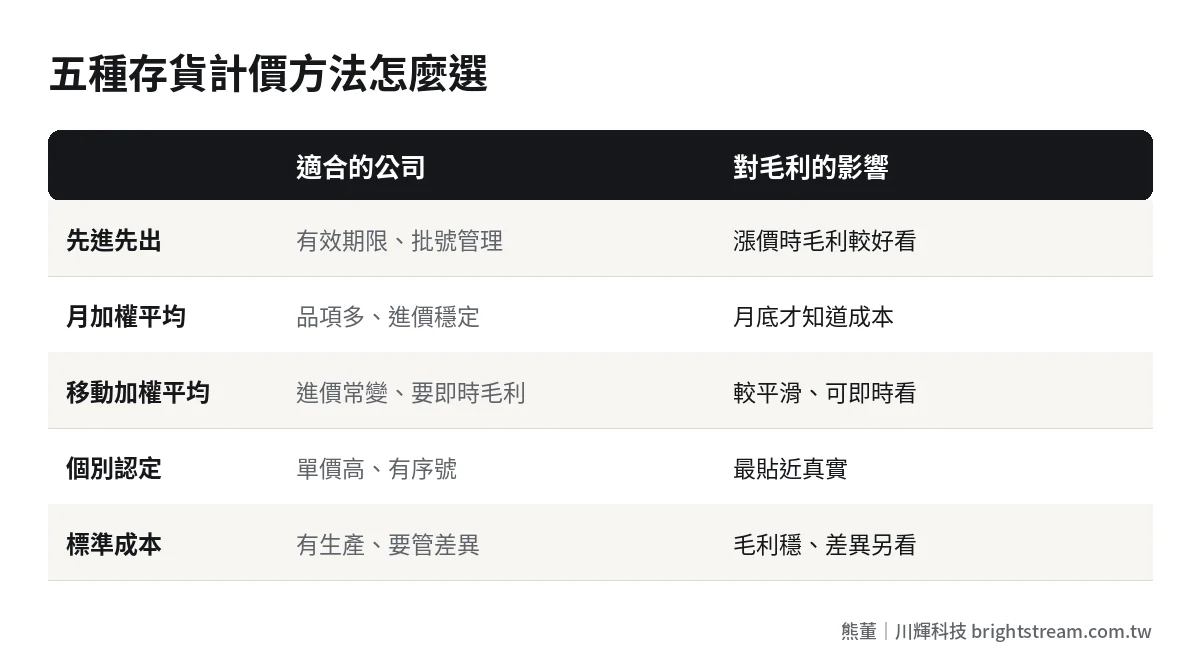
There is no right answer in this table, only what fits. A wholesaler of baking ingredients with a few hundred SKUs and prices that change once a quarter is fine on monthly weighted average. A company importing equipment, where every unit has a serial number, needs specific identification to see what each unit earns. The cost of choosing wrong is not breaking the law. It is that the margin you see is not the margin you need to make decisions.
Same month, different method: how much does margin change?
Take a hypothetical example. Say one item gets three batches this month, with purchase prices rising each time. 200 units are sold in the same month at NT$150 each:
- 1st: receive 100 units at NT$100 each
- 10th: receive 100 units at NT$110 each
- 15th: sell 150 units
- 20th: receive 100 units at NT$120 each
- 25th: sell 50 units
Revenue this month is NT$30,000 in every case, but margin differs depending on the method:
| Hypothetical calculation (NT$) | Cost of goods sold | Gross margin | Margin % | Month-end inventory value |
|---|---|---|---|---|
| FIFO | 21,000 | 9,000 | 30.0% | 12,000 |
| Moving weighted average | 21,500 | 8,500 | 28.3% | 11,500 |
| Monthly weighted average | 22,000 | 8,000 | 26.7% | 11,000 |
| Sales rep's mental math using latest purchase price | 24,000 | 6,000 | 20.0% | N/A |
Same month, same goods, and margin can land anywhere from 20% to 30%.
Three things to read from this table. First, when purchase prices rise, FIFO margin looks better, because the cheap old stock is what got sold. But the expensive new stock is what stays in the warehouse, and it shows up next month. Second, for the first three methods, cost of goods sold plus month-end inventory always equals NT$33,000 — exactly what was spent on purchases this month. The method only slices the pie. It does not make the pie bigger. Third, and most often missed: the last row is the number many sales reps carry in their heads when quoting, while the accountant uses a different one at month-end. When those two people say "margin," they are not talking about the same thing.
"Pick the right method and margin will be accurate" is only half right
Let me take the owner's side first. The instinct makes sense. In industries with volatile purchase prices — raw materials, imported goods, items exposed to exchange rates — the wrong method really does distort margin. At a company on monthly weighted average, a sales rep quoting mid-month cannot get the current cost and has to go on gut feel or grab the latest purchase price. That pain is real.
But what I see on site is mostly not a method problem. Plenty of companies switched methods and margin kept jumping, because cost never entered the system at the right time or at the full amount.
A costing method is more like a scale. However accurate the scale, if you put only half the thing on it, the reading is still wrong. The six leaks below are that missing half.
Six cost leaks that make margin fake
1. Freight, duties and customs fees arrive late and never reach that batch
With imported goods or bulk materials, the goods arrive and get received into stock first, but the paperwork for freight, duties, customs brokerage and insurance may come a week or two later. If that money is booked straight as this month's expense instead of added back to the batch's cost, every unit in the batch is costed too cheap. When it sells, margin looks higher than it really is, and on the expense side the overall P&L looks off.
2. Goods arrive first, invoice comes later, no accrual
The supplier delivers first and issues the invoice at month-end, sometimes with the price still under negotiation. If stock is not costed at an estimated price when received, and cost is only filled in when the invoice arrives, anything sold in between may carry a cost of zero or the old price.
3. The system allows negative stock
The warehouse hasn't received the goods yet, sales ships anyway, and system stock goes negative. What cost does that shipment carry? Many systems grab the last cost, or even zero. When the receipt is entered later, cost gets adjusted backward. Result: this month's margin is bloated, and next month it mysteriously thins out. Negative stock is often the main cause of the heart-monitor margin.
4. Supplier allowances and year-end rebates booked in one lump
You agree with a supplier on a rebate once you buy past a certain volume, and they issue the credit at year-end. If the whole amount hits December, December margin spikes while the previous eleven months were all understated. Sales and the owner spent the whole year making decisions on a margin that was too low.
5. Scrap, giveaways and samples never written out
Samples sent to customers, promotional giveaways, expired goods that were scrapped — if they are not written out in the system, they are still sitting on inventory. Book inventory runs high, average cost gets distorted, and the loss gets recognized all at once at the year-end stocktake. I broke down why the books and the shelves never match in Stocktake never reconciles? Six sources of inventory mismatch.
6. Manufacturers don't assign labor and overhead to work orders
For a company that produces, cost is more than raw materials. If labor and manufacturing overhead are not allocated by work order, finished goods cost only includes the materials, and of course margin looks good. I covered this blind spot fully in Your costs might be wrong: cost blind spots in small manufacturers.
These six leaks share one thing: none of them is the accountant miscalculating. They are gaps in the timing and process of data entering the system. So plugging them means changing process — for example, "no shipping without a receipt" or "expense documents must be linked back to the purchase order" — not telling the accountant to work late at month-end.
Fixing all six at once is too much. I usually suggest this order: turn off negative stock first, because it affects every shipment. Then handle freight and duty allocation, because it affects every incoming batch. Leave rebates, scrap and work-order cost for later; those affect specific months or specific items. Once the first two are fixed, the margin curve usually flattens out first, and only then can you see the real cause of whatever jumping remains.

Owners actually need to look at two different margins
Many companies never think this through: there are really two margins, and they serve different purposes.
The first is financial margin. Calculated after month-end close using the costing method your accountant approved. Used for taxes, the P&L, and explaining to the bank. It needs to be consistent and traceable. It does not need to be real-time.
The second is decision margin. What sales looks at when quoting, and what the owner looks at when deciding whether to take an order or run a discount. It needs to be real-time — ideally, the moment you hit "quote," you know what this order earns and where the floor is.
The problem is that many companies only have the first one. Sales can only quote on gut feel or the latest purchase price, then the accountant comes up with a different number at month-end. Sales says the order made 30%, accounting says 20%, and nobody knows where the gap is.
My recommendation: run financial margin on whatever method your accountant decides. For decision margin, show it in real time in the system using moving weighted average, or "latest purchase price plus allocated costs," and let sales see the floor while quoting. For why quotations so often get margin wrong, Why your quotations keep getting margin wrong covers three cost black holes where the shop floor never reports back. Read them together.
Before implementing or switching systems, ask the vendor these five questions
If you are evaluating a new system, or your current system's margin is never accurate, take these five questions straight to the vendor. They are not about whether a feature exists. They are about how the process actually runs:
- Which costing methods does the system support? If we change methods later, what happens to historical data?
- Can it block negative stock? If sales absolutely has to ship first, how is cost recorded temporarily and adjusted afterward?
- When costs like freight and duties arrive late, can they be allocated back to that batch's cost?
- How are accrued receipts handled? When the invoice price differs from the estimate, how is the difference handled, and which month does it go to?
- Can sales see real-time cost on the quotation screen? How does that cost differ from the accountant's month-end cost?
If the vendor can answer these five clearly, they have actually worked with companies that carry inventory. If all you hear is "we support all of that" and they can't walk through the process, margin will still jump after go-live. For companies running inventory and accounting in two separate systems, see How to connect ERP and accounting software for how cost carries all the way into the books.
Frequently asked questions
Can we change our inventory costing method whenever we want?
Not recommended, and usually you can't just switch. A costing method is an accounting policy. Once chosen, it should be applied consistently. Changing it needs a legitimate reason and a discussion with your accountant first, otherwise margins before and after can't be compared. The sensible time is when implementing a new system or when the way the business operates changes.
Which gives higher margin, FIFO or weighted average?
When purchase prices rise, FIFO usually shows higher margin, because the cheaper old stock is what gets sold. When prices fall, it's the opposite. Added up over the long run the gap is small; the difference is which month it lands in. The choice should be based on what you sell and what you need to manage, not on making a particular month look good.
Can we calculate moving weighted average with inventory in Excel?
You can calculate it, but keeping it correct is hard. Every purchase and every shipment has to be recalculated in time order. One late entry or one out-of-order line and everything after it drifts. Once you have many SKUs and frequent movement, it's time to hand it to a system.
Margin is never accurate. What do we check first?
Check for negative stock first, then check whether freight, duties and similar costs are being allocated into cost. These two are the most common and the easiest to confirm: have your accountant pull the items that went negative at any point in the last three months, plus the posting dates of expense documents. That usually shows why margin is jumping.
Closing: accurate margin depends on cost coming in on time and in full
A costing method slices the pie. It doesn't bake it. Choose a method that fits what you sell and that your accountant approves, then plug the six leaks — freight allocation, accruals, negative stock, rebates, scrap and samples, work-order cost. Only then is the margin you see real. Once margin is accurate, the next step is looking by customer and by item at who is actually making you money. For that, read Which customer is actually losing you money.
If your margin jumps every month and you can't say which step is breaking, bring your last three months of reports. We'll use a free 30-minute diagnostic to find which leak it is.