

“I'm paying a vendor so I don't have to tie up my people. Everyone already has more work than they can finish. Who has time to sit in meetings with them?” I hear this a lot before contracts are signed. The owner's logic is simple: let the professionals handle the professional work, and my staff keep doing their jobs. Then two months into the project, the vendor's questions go unanswered, scheduled tests go untested, and the go-live date slips again and again.
I'm Johnny Yang, founder of Brightstream Technology in Taiwan. I've led teams building systems for seven years, handled more than 252 projects across more than 32 industries. Across those projects, the difference between the ones that went live and the ones that got stuck was rarely the vendor's technical skill. It was usually whether the client company assigned the right people internally and gave them the right amount of time.
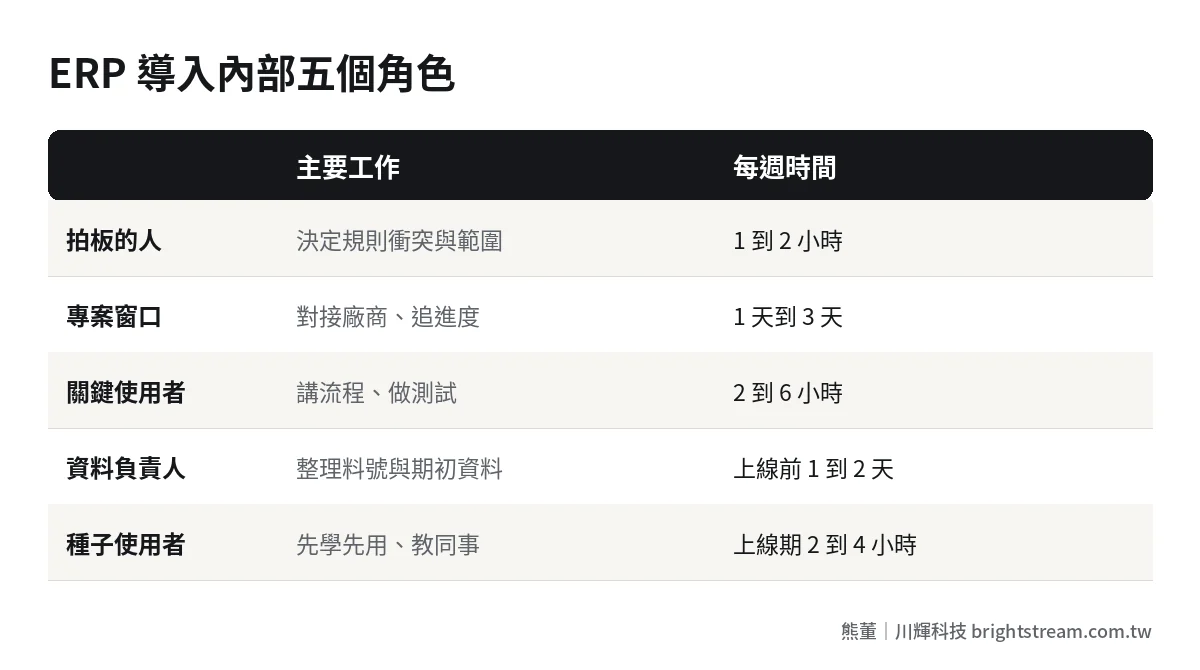
My answer: an ERP implementation needs at least five internal roles — the owner or general manager who makes the calls, an internal project coordinator, one key user per department, a data owner, and a few frontline seed users. On time, this is the starting point I use when scheduling a project: the owner, 1 to 2 hours a week; the internal coordinator, about one day a week during requirements and two to three days a week during testing and go-live; key users, 2 to 6 hours a week; the data owner, one to two days a week in the month before go-live. Add it all up, and a 50- to 100-person company running a six-month implementation needs roughly one extra full-time person's worth of hours internally. That cost is not on the quotation. But if you don't budget for it, no vendor, however strong, can get you live.
“Just leave it to the vendor” is half right
I'll start on your side. You're paying the vendor, and they should carry most of the work: organizing requirements, designing workflows, writing code, testing, training. If the vendor expects your people to write up the requirements and hand them over, that vendor isn't professional enough.
But there are four things no vendor can do, no matter how good. Only your people can.
First, deciding the rules. Who can give a special price to a given customer, whether returns are deducted from sales commission, who gets shipped first when stock runs short — these are company decisions, not system settings. The vendor can ask. The vendor cannot decide for you.
Second, cleaning up the data. Part numbers, customers, suppliers, opening inventory. This data lives in your company's Excel files and on individual people's computers. Which records are correct and which went out of use years ago — only your people know.
Third, testing with real cases. The vendor tests whether the function works. Your people test whether the floor will get stuck doing it this way. Whether last month's nightmare order runs smoothly through the new system — only the person who handled it knows.
Fourth, convincing coworkers. When a new system goes live, the floor may or may not listen to the vendor. They will listen to the coworker next to them who already knows how to use it.
So the question isn't whether to assign people. It's who, and how much time. If you don't assign anyone, the vendor has to guess, and every wrong guess blows up at once after go-live, as change orders or rework. Who should own the whole project is covered in Who should own an ERP implementation. This post covers who else you need beneath that owner, and how much time each one spends.
The five roles: what each one actually does
A note first: the hours below are the starting point I use when scheduling projects, to give owners a sense of the budget. They are not statistics. The bigger the company, the more departments, the messier the data, the more you add.
| Role | Who fits | Main work | Weekly, requirements and development | Weekly, testing and go-live |
|---|---|---|---|---|
| Decision-maker | Owner or general manager | Resolves rule conflicts, scope trade-offs, sign-off | 1 hour | 2 hours |
| Internal project coordinator | Someone who knows company-wide workflows and whom every department will work with | Liaises with vendor, tracks progress, collects issues | About 1 day | 2 to 3 days |
| Department key user | One per department, the person who knows daily operations best | Explains floor workflows, tests, confirms screens | 2 to 3 hours | 4 to 6 hours |
| Data owner | Accountant or senior assistant who knows the master data | Cleans part numbers, customers, opening balances | 2 to 4 hours | 1 to 2 days a week before go-live |
| Frontline seed user | One or two per frontline unit | Learns first, uses first, teaches coworkers | Almost none | 2 to 4 hours |
Decision-maker: least time, but cannot be absent
The owner only needs one hour a week, but that hour has to be fixed. During implementation, two departments will always want conflicting things: sales wants to change prices any time, accounting wants prices locked. The coordinator can't decide that. Only the owner can. If the owner doesn't show up for two weeks, the project stalls for two weeks.
Internal project coordinator: the most critical person on the project
The coordinator is the vendor's only fixed contact inside your company. They need to know how each department works, be able to pull people into meetings, and, when the vendor asks a question, give an answer the same day or find the person who can. Pick the wrong person here and everything after slows down. How to pick is covered separately below.
Department key users: putting the floor into words
Sales, purchasing, warehouse, accounting, production — each department sends the person who knows daily operations best. During requirements, they answer “how do you do it now, and where does it hurt most.” During testing, they run real documents through the new workflow. For how to ask the questions that get to the point in a requirements interview, see How to run a requirements interview: find the real problem in 90 minutes.
Data owner: the most underestimated role
Many projects discover in the last month that the opening data simply can't be cleaned in time: duplicate part numbers, customer names spelled three different ways, inventory numbers far off from reality. The data owner has to start on day one of the project, and the month before go-live is their busiest. How much work it takes to move old data over is broken down in The real cost of ERP data migration.
Frontline seed users: the go-live week fire crew
Seed users learn and use the system one or two weeks before go-live, then sit next to coworkers during go-live week to help. When something goes wrong on the floor, people ask them first instead of calling the vendor for everything. When choosing seed users, don't pick the most senior people. Pick people willing to try new things whom coworkers trust.
What it adds up to: a hypothetical calculation
Only when you add up the hours above do you see the cost everyone ignores.
Say an 80-person company implements ERP over about six months from requirements to go-live, with five departments. On average, weekly internal time looks roughly like this: owner 1.5 hours, internal coordinator 12 hours, five key users at 3 hours each for 15 hours, data owner averaging 6 hours, three seed users at 2 hours each for 6 hours. Total: about 40 hours. In other words, for those six months the company carries one extra full-time workload, just spread across a dozen or so people.
That doesn't mean you need to hire someone. It means admitting this time won't appear out of nowhere. If everyone squeezes it in on top of their existing job, the usual result is both sides suffer: the regular work falls behind, and the project's questions sit unanswered. In the end the project runs late, and both the vendor's billable days and your internal time stretch out together.
So I tell owners to add a line to the ERP budget called “internal time.” It doesn't have to be converted into money, but at minimum it should list who, how many hours a week, for how many months, and decide in advance how those people's regular work gets reassigned.
How to pick the internal project coordinator: three common wrong choices
The coordinator is the most important of the five roles, and the one most often picked wrong. I've seen the following three choices on site many times.
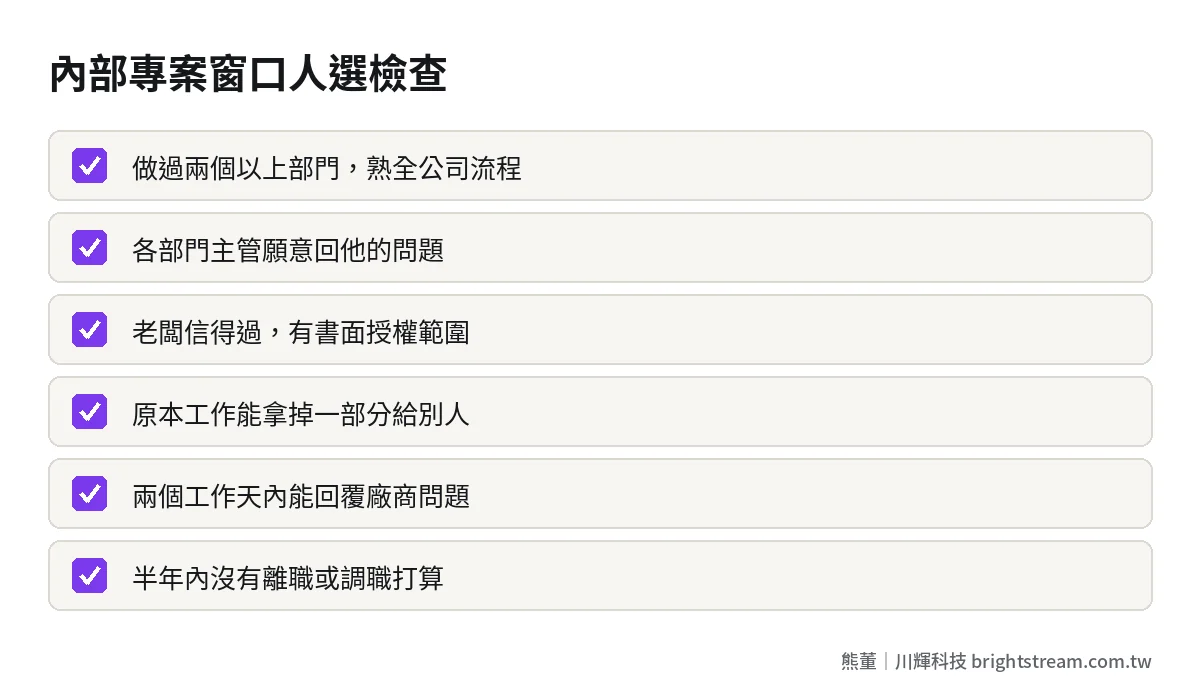
Picking the least busy person. “He has less on his plate, let him deal with the vendor.” The problem is the least busy person is usually the one who knows company workflows least and carries the least weight with other departments. The vendor asks one question, he has to go ask three people, and one question takes a week.
Picking the IT person. It feels intuitive: system work goes to the person who knows computers. But ERP implementation is 80% process and rules, 20% technology. The IT person can handle accounts, networks, and devices, but doesn't necessarily know why sales and accounting are fighting.
Picking the newly hired assistant. New hires have time and are willing to learn, but they don't know the company's past rules, don't know which exceptions are actually routine, and department heads may not take them seriously.
A better coordinator is usually a mid-level manager or senior assistant who has worked in two or three departments, has been at the company a while, and has the owner's trust. They may not know computers best, but they know who to ask, and people are willing to answer them.
How to make sure these people actually have the time
Assigning people doesn't mean they have time. Before the project starts, I ask the owner to do these four things:
- Take part of the coordinator's existing work away. State clearly which tasks go to someone else for these six months. Otherwise they will always do their regular work first.
- Give the coordinator clear authority. Write down which things they can decide directly and which need to go to the owner. Otherwise every small issue waits on the owner, and the coordinator is just a messenger.
- Hold a fixed weekly project meeting. Fixed time, fixed attendees, and the owner attends at least every other week. The meeting covers only three things: what got done last week, what's stuck, and who needs to decide what.
- Agree on a response deadline. Set how quickly the vendor's questions must be answered internally, for example within two business days. Anything past the deadline, the coordinator escalates. It doesn't get left sitting.
Do these four things and the internal team is actually a team, not a list of names on paper. For how to run training around go-live and get more people using the system, read How to run ERP training people actually use. For how to staff the period when old and new systems run side by side, see How long to run old and new systems in parallel.
Warning signs your internal team is about to break
A well-planned team doesn't guarantee six smooth months. If any one of the four signs below appears, the owner should step in without waiting for the vendor to raise it.
Someone starts regularly missing the weekly meeting. Missing once may mean they're genuinely busy. Missing twice in a row usually means their regular work was never taken off their plate, and the project has dropped to the bottom of their list.
The vendor's question list keeps growing. More open questions are added each week than get resolved. This means the coordinator lacks authority to decide, or can't find anyone who can.
Test feedback is just “OK.” The key user never actually ran real documents through. They glanced at the screen and replied. A system that passes this kind of testing will break in the first week after go-live.
The coordinator starts saying “let's deal with that after go-live.” Some things genuinely can wait. But if even the rules are being put off until after go-live, there's no internal consensus yet. It's just being pushed back.
One more risk to plan for: people changing mid-project. When the coordinator or data owner leaves or transfers partway through, the handover often includes only the documents, not the context of why decisions were made. So I recommend recording every decision from every project meeting and keeping it all in one place. When someone new takes over, they at least have something to read.
When Brightstream does an implementation, before giving a quotation we confirm with you which people you'll assign internally and roughly how much time each week, and we write that into the written feature list and schedule. System implementation starts at NT$300,000, quoted to your specifications as a fixed amount and paid in stages; each payment is collected only after the agreed result is delivered. If you can't free up the internal staff, I'll recommend narrowing the scope rather than forcing it.
FAQ
Does an ERP implementation need a full-time project coordinator?
Not necessarily full-time, but it needs a fixed person with fixed time. At a company of around 50 people, the coordinator can usually do it alongside their job, provided someone covers their regular work during the one or two months of testing and go-live. If the coordinator can't free up even half a day a week, the project will almost certainly be delayed.
Does the owner have to attend every weekly meeting?
Not every one, but at least every other week, and always at key milestones: requirements confirmation, workflow sign-off, and acceptance. If the owner is absent for long stretches, the coordinator can't resolve rule conflicts on your behalf, and issues keep piling up.
If we really can't spare internal staff, can we hand everything to the vendor?
You can have the vendor take on more of the organizing and documentation. But deciding the rules, confirming the data, and testing with real cases can still only be done by your people. If you truly can't free anyone up, the better move is to shrink the first phase — go live with one or two departments first instead of all at once.
Should key users be managers or frontline staff?
Pick whoever knows daily operations best. That's usually senior frontline staff or a team lead, not necessarily a manager. Managers know the rules but don't always know how work actually gets done every day or where the exceptions are. The best combination: the manager decides department rules, and the senior staff member explains workflows and does the testing.
Half of whether your ERP goes live is outside the quotation
In the end, an ERP implementation has two costs: one on the vendor's quotation, and one on your own staff's calendars. If the second isn't budgeted, it doesn't matter how much you spend on the first — the project will stall. Assign the right people, give them the right time, and give them authority to decide. Do those three things and the project is most of the way to success.
If you're planning an ERP and aren't sure who to assign internally or how much time to set aside, start with How to do an ERP implementation, and count your internal team as part of step one.