
The most common way a startup dies early isn't a lack of business. It's the rush to look like a company.
A nice office, upgraded equipment, hiring ahead of demand, expanding the scope of operations. These moves look professional and established. They are also the most common reason new companies collapse. This isn't theory. I ran a company with a big headcount and lost NT$7,000,000 in three years. I paid real money for every item on that list.
I'm Johnny Yang. I've been a serial founder for seven years, and my teams have delivered 252+ projects across 32+ industries. This post lays out the survival logic I bought with NT$7,000,000. If you're about to start a company, or you're treading water in year one, read this before you spend your next dollar.
1. Companies never fail from earning too little. They fail from spending too much
The first goal of a startup is not profit. It's survival.
Until your cash flow is stable, every fixed cost is slow poison: office rent, admin salaries, long-term subscriptions, equipment. The scariest thing about these costs is that they don't shrink when you have a bad month. They eat cash on schedule every month, whether money comes in or not.
My version: before we had stable revenue, I leased an impressive office because I thought clients needed to see something respectable when they came in to talk. Clients didn't care about the office at all. The landlord cared a lot about the rent. There is only one correct order: prove you can survive, then talk about expansion.
2. Looking like a company is the most expensive vanity
Plenty of founders land their first project and immediately build a team and rent space, thinking a bigger operation attracts more clients. But a company's real size isn't how it looks. It's its cash flow.
The year-one to-do list is honestly boring: work from home or a coworking space, outsource everything non-core, keep the organization able to shrink at any moment, cut fixed costs to the bone. Your goal isn't to look like a company. It's to outlast the people who look like a company.
In the AI era this has a new version. The output one person can carry is completely different from five years ago. How I started over alone is in "How to start a one-person company: I lost NT$7,000,000, started over, and kept only these 5 things", the sequel to this post.
3. Outsourcing isn't about saving money. It's risk management
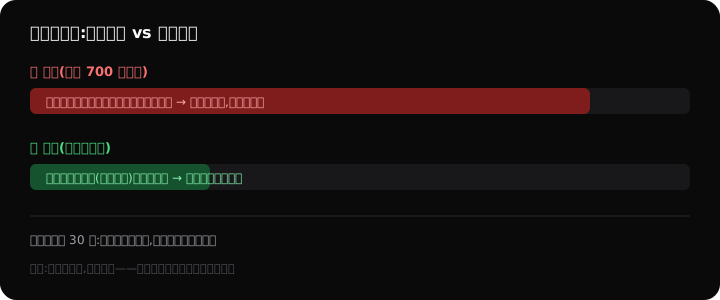
To save money, founders do everything themselves: design, marketing, the website, accounting, social media. They end up spending all their time on things they're bad at, and the work that actually brings in revenue, meeting clients and delivering, gets no time at all.
Outsourcing isn't really a cost. It turns fixed costs into variable costs: you spend only when there's a project, and you carry no payroll when there isn't. You get your time back, you keep your flexibility, and you get expertise immediately. As long as your service is worth enough, outsourcing is always safer than hiring staff in year one.
To decide what to outsource and what to keep, I ask one question: Can the rules for this task be written down? If they can, hand it off (to a contractor or to AI). If they can't (judgment, quotations, client relationships), keep it yourself. The full version of this test is in "The subtraction logic of starting a business".
4. The harshest test: if your expertise can't support you, it isn't a business model
If your income can't cover the outsourcing you need and can't cover your own living costs, it's not because you aren't working hard enough. The market is telling you it won't pay this price for this thing.
What you need then isn't more grind. It's a redesign: change your customers (sell the same skills to people who can pay), change your delivery (turn one-off services into recurring fees), change your positioning (from "the person who does the work" to "the person who solves the problem"). Between losing NT$7,000,000 and later running a one-person company that passed NT$10,000,000 in revenue in ten months, the biggest change wasn't my skills. It was repackaging "what I can do" as "who urgently needs this, and how much they'll pay".
Frequently asked questions
Q: Should I rent an office in my first year? The default answer is no. There are only two exceptions: your industry legally requires a registered address (solve it with a business center for a few thousand NT dollars a month), or your type of client really will visit in person (first confirm how many times that will happen, then work out whether it's worth burning tens of thousands of NT dollars a month on it). "Looking respectable" is not on the exception list. I tested that for you. It's part of my NT$7,000,000 tuition.
Q: When is it actually OK to expand? My standard: six consecutive months of stable positive cash flow at your current size, and the bottleneck is clearly capacity, not orders. Expanding capacity while orders are unstable means spending money you haven't earned yet. That's just another version of spending receivables as if they were cash, and it's where the largest chunk of my NT$7,000,000 went.
Q: What should I spend money on in year one? Things that directly generate revenue or directly save you time: tools for taking on work, key outsourcing, and the places where you get to meet clients. One simple line: within three months of spending this money, can you point to the revenue it brought in or the hours it saved? If you can't, don't spend it in year one.
Survive first. Then you get to tell the story
The full story of losing NT$7,000,000 in three years, how each step went wrong and how I later started over alone, is on my Chinese-language podcast "熊董不上班", updated every Wednesday. If your company is reworking its cash flow or operating structure, our library of 252+ projects has approaches from similar situations, or book a free 30-minute diagnostic: pick a time that works for you online, and I'll help you find the fixed cost you should cut first.