"Johnny Yang, someone called saying they can get us a government grant. The government pays half the system cost, and they only charge if it's approved. Is this legit?"
A lot of owners have taken this call. It sounds like a good deal. You already wanted a system, someone will write the proposal, and the government covers part of the cost. There seems to be no reason not to. But I usually ask the owner one question first: without this grant, would you still build this system?
I'm Johnny Yang, founder of Brightstream Technology in Taiwan. I've led system implementation projects for seven years: more than 252 projects across more than 32 industries, and over NT$20,000,000 a year in custom-built systems delivered. Plenty of owners have asked me about grants over the years. The ones who actually get stuck usually aren't stuck on eligibility. They haven't worked out what they need.
My conclusion: a grant is an accelerator, not a reason. Digital transformation and AI grants usually take applications for a very short window (for example, the SMEA's ROC year 115 (2026) "AI Innovation Application Assistance for Micro, Small and Medium Enterprises" was announced April 2 and closed April 30 at 5 p.m.), and the deadline for submitting missing documents is short too. If you start deciding what to build after the announcement comes out, you're almost always too late. Get three things ready before you apply. First, the basic company documents: registration, tax, and credit certificates, plus financial statements and factory registration for some programs. Second, a plan that states the pain point, the scope, the timeline, and measurable targets, because reviewers score need, feasibility, and replicability. Third, a decision that stands without the grant: if the grant falls through, do you still build it, and how big. With these three ready, you can catch the grant when it comes. Without them, even if you get the money, the system will likely end up as something built just to close out the grant.
Which grants appear in the 2026 official announcements?
First, the official material I actually read. Below I list only what I confirmed by opening the official pages. For actual terms, amounts and timelines, the latest announcement from each agency is what counts.
| Program | Agency | Who it fits | Key conditions in the 2026 announcement |
|---|---|---|---|
| AI Innovation Application Assistance for Micro, Small and Medium Enterprises | Small and Medium Enterprise and Startup Administration (SMEA), Ministry of Economic Affairs | Micro, small and medium enterprises that want to implement AI | Paid-in capital of NT$100,000,000 or less, or fewer than 200 employees; applications until 5 p.m., April 30, 2026 (ROC year 115), reviewed on a rolling basis |
| AI Digital Transformation for Succession in Small and Medium Manufacturers | Industrial Development Administration (IDA), Ministry of Economic Affairs | Small and medium manufacturers with a succession plan | Up to NT$8,000,000 per project, capped at 50% of total project cost; requires a successor nomination letter |
For the SMEA program, the SMEA press release shows it was published April 2 and took applications until 5 p.m. April 30, reviewed on a rolling basis until funds run out, with a target of helping 2,500 companies complete AI implementation. Its application guidelines state that applications must be submitted on paper, with the postmark as proof of date. Eligibility, required documents and scoring are all laid out clearly.
For the IDA succession program, the assistance resource page lists these conditions: small and medium manufacturers with factory registration, up to NT$8,000,000 per project and no more than 50% of total cost, a nominated successor who serves as project lead, and an announcement expected "around February".
These two programs tell you one thing: the windows are short, and it's first come, first reviewed. If you wait until you see "grant applications open" in the news to start figuring out what to build, you usually have only a few weeks left.
"Apply first, figure it out later": where this instinct is right and where it's wrong
First, the owner's side. Applying when there's a grant is a perfectly reasonable instinct. The government is willing to share the risk, a process you already wanted to fix gets fixed sooner, and writing the proposal forces you to think your needs through. For SMEs on a tight budget, that's real help.
The real problem is the order. Many companies see the grant first, then decide what to build. So the scope gets written to fit the grant's theme, not the company's actual pain point. The grant wants AI, so an AI feature gets forced in. The grant scores replicability, so the system gets written up big and supposedly connects every department.
There are three common outcomes. One: the application fails, but the company has already spent weeks writing the proposal and sitting in meetings, and the real problem hasn't moved. Two: the application succeeds, what gets built doesn't match what the floor needs, and nobody uses it after closeout. Three, the most expensive: the system is bigger than needed, the grant covers only part of it, and the company carries the rest of the cost plus every year of maintenance afterward on its own.
So I suggest owners flip the question: first decide which one problem you're solving and how far you'll take it, then see whether a grant happens to fit. If it fits, apply. If it doesn't, build it yourself as planned, or shrink the scope and start smaller. I wrote about where digital transformation should start in What SMEs should do first in digital transformation. It's the same logic about order.
Documents to prepare: you can start now
Documents take the least thinking and cause the most delays. Take the SMEA ROC year 115 AI Innovation Application Assistance guidelines as an example. Required documents must be stamped with both the company seal and the responsible person's seal, and include:
- Proposal application form
- Registration certificate (must show the current responsible person's name)
- Tax certificate (either the most recent year's corporate income tax profit-and-loss and tax computation statement, or proof of the most recent business tax filing)
- Credit certificate (either proof the company is not a rejected bank account holder or proof of no bounced checks in the last three years)
- Proposal presentation
The IDA succession program asks for more: factory registration, CPA-audited financial statements or income tax return financials, a Taiwan Clearing House credit inquiry report issued within six months before the deadline, and proof of the successor's qualifications.
None of these are hard, but some require a trip to the bank, some require waiting on the accountant, and some require tracking down the responsible person to stamp them. If you start collecting them after the announcement, the documents alone will eat one or two weeks. My advice: at the start of every year, put together a "standard application document pack" in a shared folder so anyone who needs it can get it.
One more thing many people miss: the SMEA guidelines state that if you don't submit missing documents within 2 working days from the day after the correction notice arrives, you're deemed ineligible. Incomplete documents and slow corrections are the most wasteful way to fail.
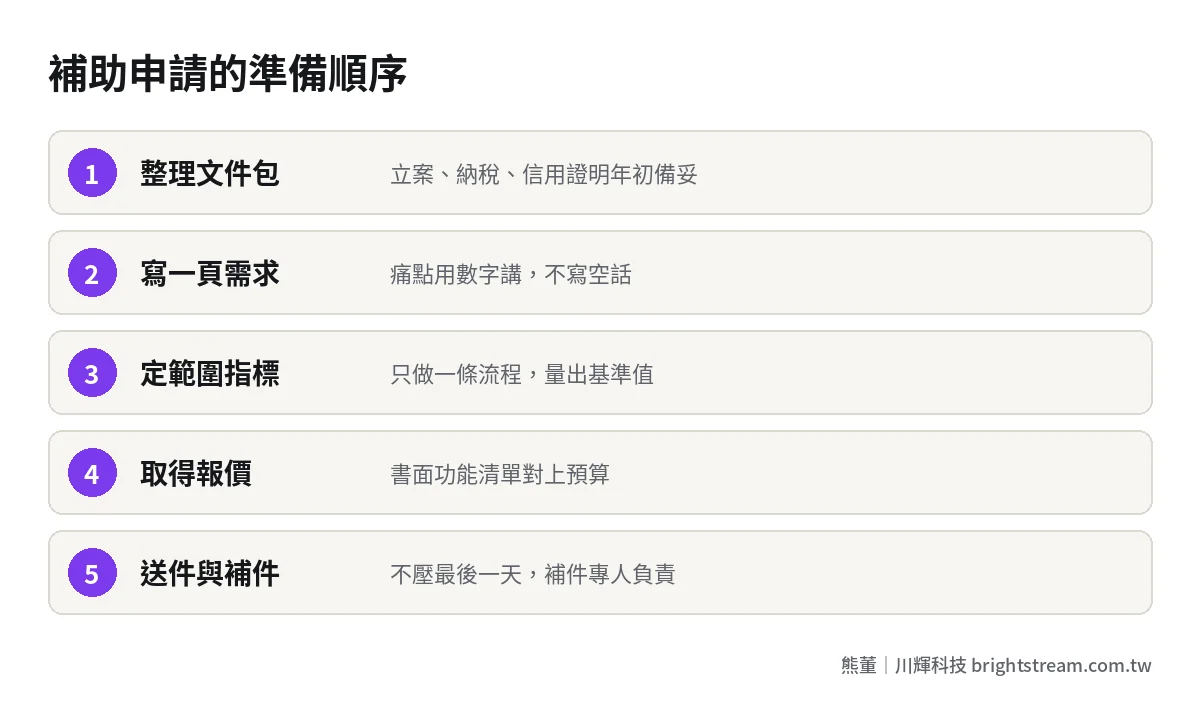
How to write the proposal so it matches the scoring
The SMEA program's presentation review scores three areas: need 30%, feasibility 30%, market replicability 40%. Weightings differ by program, but almost every grant asks the same three questions: why do it, how will you do it, and what will it deliver.
Why: state the pain point in numbers
"We want digital transformation" is not a pain point. "Sales reps spend two hours a day putting together quotations, and orders get missed every month" is. Say a 50-person company relies on one senior sales rep to calculate quotations by hand, and when he takes leave, quotations stop. A reviewer gets that immediately, and it's easier for them to judge whether it's worth funding.
How: keep the scope small enough to finish
The bigger the scope, the more ambitious it looks, but the lower the feasibility score. Write down which process you'll do first, who owns it, how many months to go live, and who needs to be involved. Someone inside the company has to actually own it. You can't hand it all to an outside vendor. For how to turn your needs into a spec a vendor can price, see How to write ERP requirements.
What: results must be measurable and repeatable
When it's done, which number changes? Quotation time, error rate, missed orders, processing hours. Pick two or three, and write down today's baseline. Replicability means whether this approach can be copied to other departments, other branches, or other companies in the same industry.
One trick for writing the proposal: write one page before you write ten. On one page, answer: where it hurts now, which number changes when it's done, who owns it, how long it takes, and what it costs. If the owner can read that page, managers can read it, and a vendor can quote from it, then expand it into the formal proposal. A plan you can't write on one page is just a plan whose vague parts are buried deeper when you write it on ten.
If you can write these three parts, the proposal has a skeleton. If you can't, your needs aren't clear yet, and the problem isn't the grant. It's that you haven't decided what you're solving.
Common reasons grant applications fail
In the table below, the first half comes from rejection and non-acceptance conditions written into the official guidelines. The second half is what I regularly see on the ground.
| Reason for failure | How to avoid it |
|---|---|
| Ineligible: Chinese mainland capital, rejected bank account holder, tax arrears in the last three years, application filed by a branch office | Check yourself line by line against the guidelines before submitting |
| Late corrections: missing documents not submitted within 2 working days of the correction notice | Prepare the standard document pack at the start of the year and assign one person to own it |
| Late submission: paper application arrives after the deadline | Don't wait for the last day; leave time for mailing and stamping |
| Overlaps with a past grant project without explaining the difference | List every program the company has applied for and spell out what's different this time |
| Proposal packaged by an agent or consulting firm | Write the plan yourself; outsiders only help organize and quote |
| Scope too big to finish | Write up one process only; put the rest in the next phase |
| Targets can't be measured | Measure today's baseline first, then write the target |
| Budget doesn't match the vendor's quotation | Get a written feature list and quotation first, then write the budget |
A word on agents. The SMEA guidelines state plainly that proposals packaged by private agents or consulting firms, or where someone claims to be "commissioned by the government" or to "know the reviewers", will not be accepted, and the program has no such commissioned parties. If you get a call promising "guaranteed approval", read what the official guidelines say before deciding whether to bother.
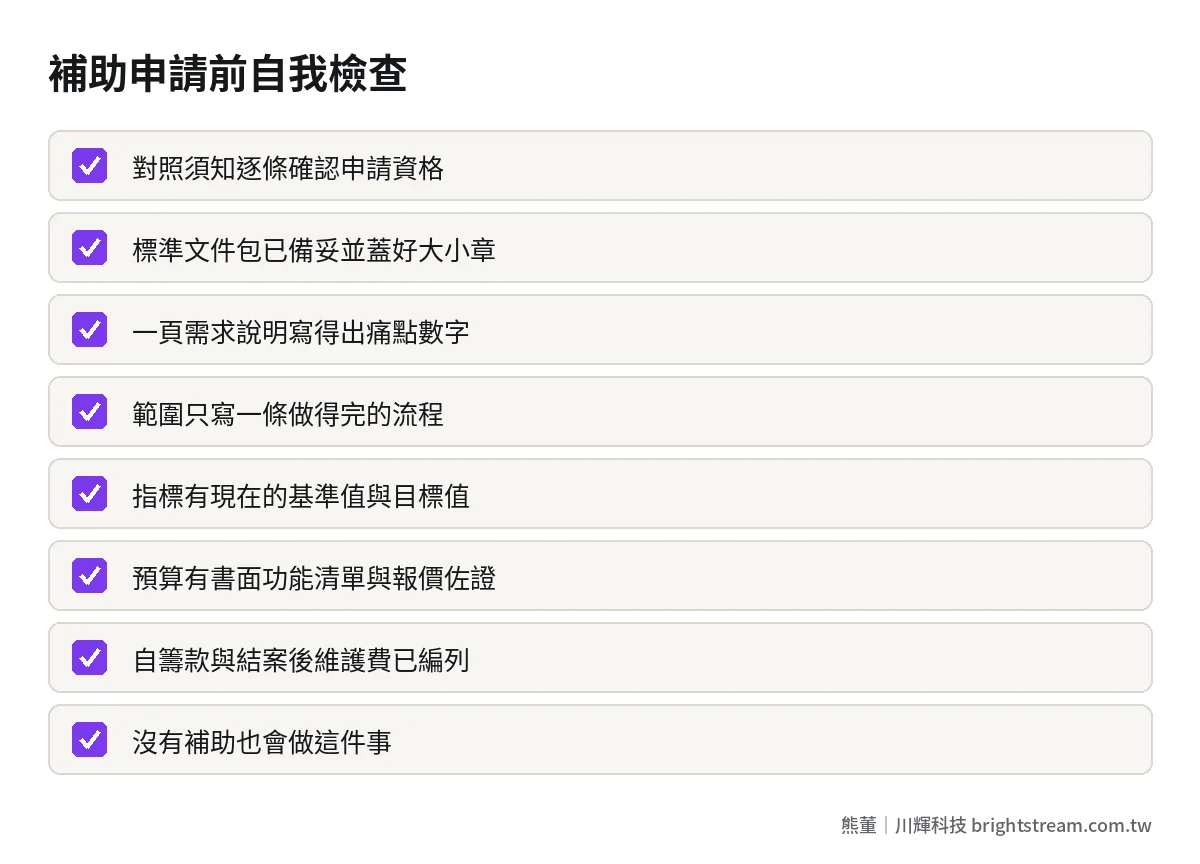
Don't let the grant decide your system
This last section is what I most want to say.
A grant has a closeout date. A system doesn't. After closeout, the system keeps running: servers, maintenance, process changes, training new hires. These happen every year, and the company pays for all of them. So when you evaluate a grant program, don't just look at how much the government pays. Look at how much the company pays over three years.
Here's a hypothetical. Say a system project costs NT$1,000,000 in total, the grant covers 50%, and the company funds NT$500,000. After closeout someone has to maintain it. Using Brightstream's starting maintenance fee of NT$20,000 a month as an example, that's NT$240,000 a year, NT$720,000 over three years. Over three years, the company pays NT$1,220,000 and the government pays NT$500,000. That doesn't mean it isn't worth doing. It means you should judge whether it's worth it at NT$1,220,000, not NT$500,000.
I ask owners to put three questions to themselves:
- Without the grant, would I still do this? If yes, the grant is an accelerator. If no, this probably shouldn't be done at all.
- Is the grant's theme the same thing as my real pain point? If you have to twist your needs to fit the theme, don't apply.
- After closeout, who maintains it, what does it cost each year, and who holds the source code? If you can't answer these three, getting the grant is only a beginning, not a result.
The thing I say to owners most often is "don't build this." Out of ten things they want to automate, about two are worth a custom system, five just need off-the-shelf tools, and three shouldn't be touched at all. A grant doesn't change that ratio. Using a grant to do one of those three just means the government wastes money alongside you. Many digital transformation projects end with nothing to show, and the reason has nothing to do with grants. Nobody defined at the start what "done" looks like. I wrote about this in more detail in Digital transformation fails mostly because the owner never defined what "done" looks like. For how to allocate budget, see How SMEs should plan an IT budget.
FAQ
Can digital transformation grants be used to implement an ERP or a custom-built system?
It depends on each program's theme and eligible expenses. Every program is different, and the official application guidelines always govern. What matters isn't what the system is called, but whether your plan can state clearly what problem it solves and which number improves when it's done. Write down your needs first, then check them against the guidelines' scope. That works better than deciding what to buy and then hunting for a grant.
Does the government pay the full cost? How much does the company have to pay?
Most programs don't pay in full. In the IDA succession program, for example, the grant covers no more than 50% of total project cost, and the company funds the rest. You also need to budget for annual maintenance and changes after closeout, which usually aren't covered.
Can I hire an agent to write the grant proposal?
In the SMEA ROC year 115 AI Innovation Application Assistance program, for example, the guidelines state that proposals packaged by private agents or consulting firms will not be accepted. The proposal is best written by the company's own project owner. Outside vendors can help with quotations, feature lists and technical descriptions, but the pain points and goals should be in your own words.
If we didn't get a grant this year, should we still build the system?
Go back to the question: without the grant, would you still do it? If this problem is leaking money or orders every day, you should do it even without a grant. Just shrink the scope to start. If you don't want to do it without the grant, it was never a high priority. Leave it for now, or handle it with off-the-shelf tools.
Closing: work out what you're solving first, and you can catch the grant
Grant windows are short, the paperwork is heavy, and scoring looks at need and feasibility. So real preparation isn't waiting for the announcement. It's having your pain point, scope, targets and document pack ready ahead of time. If a grant fits, apply. If it doesn't, build at your own pace. Whether a system should be built is not something a grant should decide.
If you have one thing you want a system to solve but can't yet state the scope and targets, bring that one thing to a free 30-minute diagnostic with me. We'll work out whether to build it and how big, so when the grant comes, you can catch it.