

“One vendor told me: you’re a factory, ERP isn’t enough, you have to go MES. Another said their ERP already has a production module, so MES is unnecessary. The quotations are far apart. Who am I supposed to listen to?” The owners who say this usually run factories of fifty or sixty people up to a hundred-plus. Delivery dates slip constantly, the plant manager chases progress in a LINE group every day, and at month-end accounting can’t tell how much any given order actually made.
I’m Johnny Yang, founder of Brightstream Technology in Taiwan. I’ve led teams building systems for seven years, handled more than 252 projects across more than 32 industries, and manufacturing is a large share of them. The thing I say to owners most often is “don’t build this.” MES is the same. Not because it’s useless, but because many factories buy it at the wrong time.
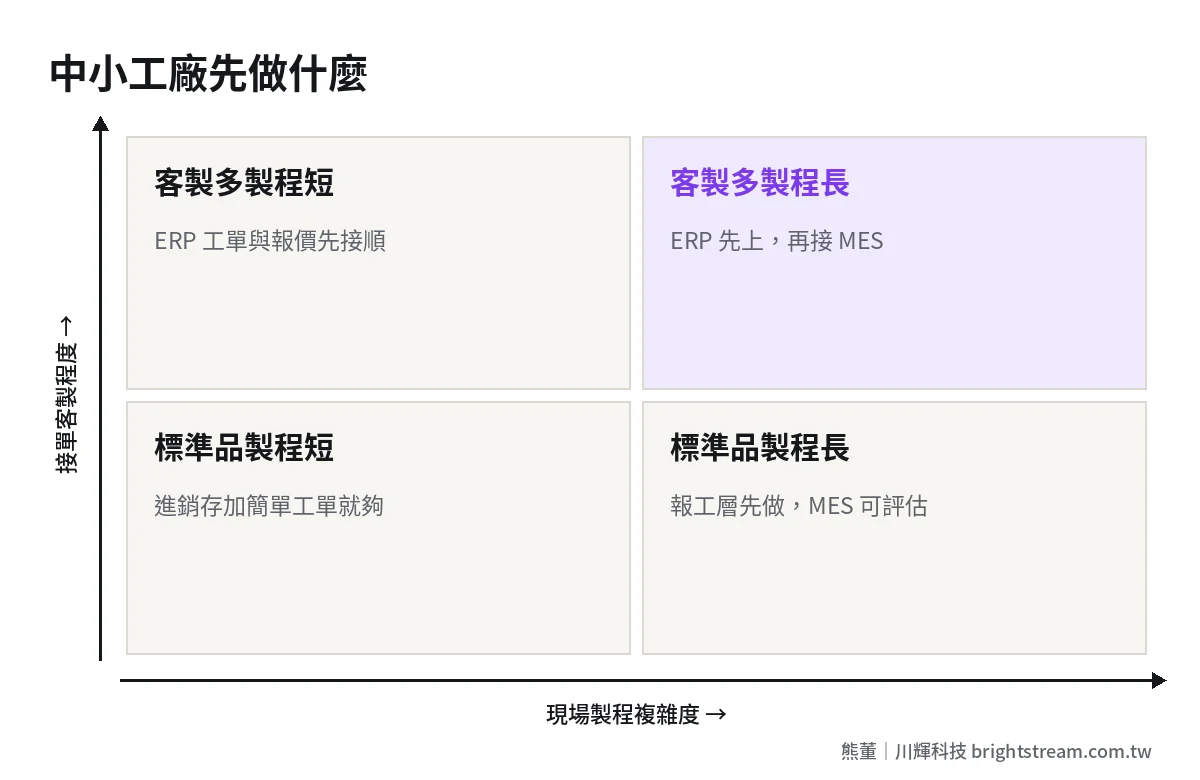
My answer: the line between MES and ERP is not “are you a factory.” It is which kind of question you need answered. ERP answers questions about money and commitments: what orders you took, which materials they need, what they cost, when you can deliver, whether you’ve been paid. MES answers minute-level questions on the shop floor: which order this machine is running right now, which raw material lot went into this batch, which station it’s stuck at, where the yield drops. For small and mid-sized factories with a few dozen to one or two hundred employees, most should first get ERP’s part numbers, BOMs, and work orders connected properly, and the shop floor only needs a “good-enough” production reporting layer. MES is worth a separate investment only when you have many machines, many process stations, customers demanding lot-by-lot traceability, or you genuinely need to manage machine utilization. Put in MES before ERP is working, and no matter how detailed your shop-floor data is, you still can’t calculate whether an order made money.
Why do two vendors give you completely opposite answers?
Start with a very practical reason: every vendor sells what they have. MES vendors see the chaos on the shop floor. ERP vendors see the chaos in the books and inventory. Neither is exactly wrong. Each is looking from their own end.
The second reason is overlapping terms. An ERP production module has work orders, production reporting, and work-in-progress. MES also has work orders, production reporting, and work-in-progress. Both call it a “work order,” but how deep each system manages it is completely different, and on the quotation they look identical. Put two quotations side by side and it’s hard for an owner to see where they differ.
The third reason is budget psychology. Factory owners are used to equipment investment. They sign off on a machine costing millions of NT dollars without blinking. But for “invisible systems,” they often want to buy the most complete package in one go so they won’t have to spend again later. The result: they buy the most complete package and use about 30% of it.
So before comparing quotations, get one thing clear: is your biggest pain “I don’t know if this order makes money or if we can deliver it,” or “I don’t know what’s happening on the floor right now”? The first is an ERP problem. Only the second is an MES problem.
How MES and ERP differ, in owner terms
There are plenty of technical definitions. I only sort them by things an owner deals with every day. The table below has an extra column, “good-enough reporting layer,” because what most small factories actually need falls in that column.
| Comparison | ERP | MES | Good-enough reporting layer |
|---|---|---|---|
| Question it answers | Does this order make money, when does it ship, have we been paid | What is this machine doing right now, where is it stuck | How far along is this work order, how many made, how many defective |
| Time resolution | By the day or shift | By the minute or even second | By the process step or shift |
| Main users | Sales, purchasing, warehouse, accounting, owner | Plant manager, line leads, QA, process engineers | Operators, line leads |
| Core data | Part numbers, BOM, inventory, orders, cost | Machine status, lot numbers, process parameters, yield | Start, finish, quantity, defect reason |
| Without it | Margins are guesses, delivery dates are shouted | Floor problems are known only when someone notices | Work order progress means asking someone |
| Implementation touches | Company processes and master data | Floor equipment, workstations, how work is done | Floor reporting habits |
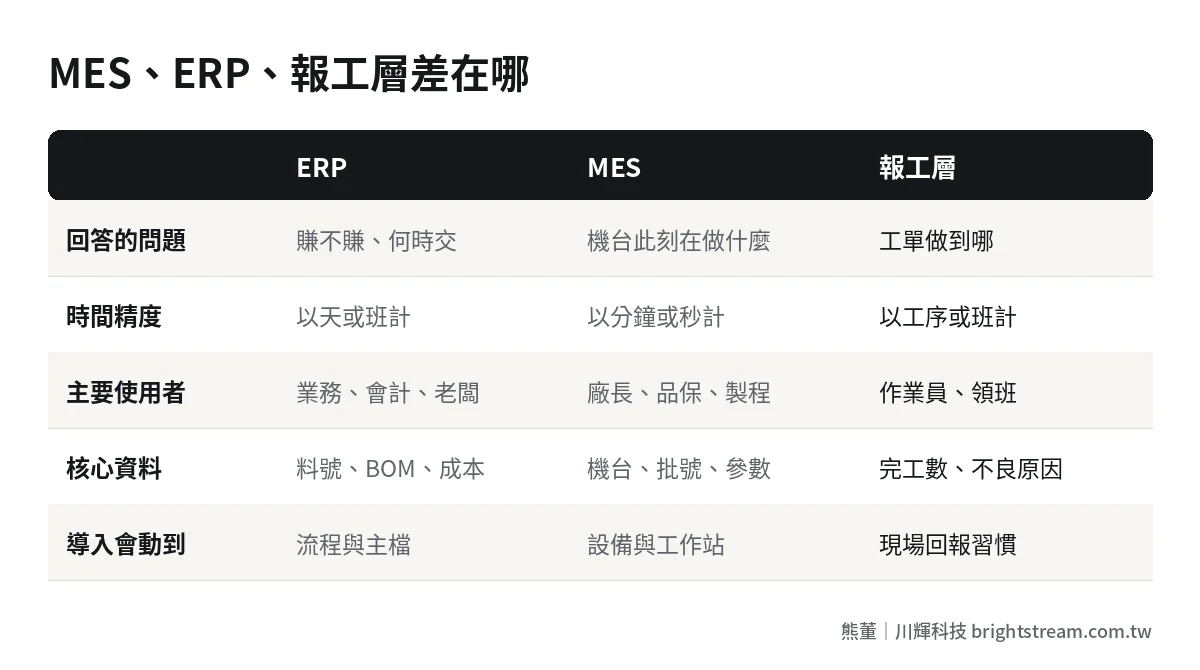
The table shows one thing: ERP is the company-level ledger, MES is the floor-level ledger. Both need someone to report production, but ERP only needs to know “how many were finished, how much material was used,” while MES needs to know “what time, on which machine, with what parameters.” The resolution differs by an order of magnitude, and so do the implementation cost and the burden on the floor.
“We’re a factory, of course we need MES” is half right
First, I’m on your side. Most factory problems are seen on the floor: missed delivery dates, defective products returned, rush orders wrecking the schedule. Problems blow up on the floor, so an owner wanting to start on the floor makes complete sense. And MES is the system built to manage the floor. It sounds like the right medicine.
But here’s the real problem: the problems that blow up on the floor often don’t start there. Missed delivery dates often happen because nobody checked materials or capacity when the order was taken. Defects that can’t be traced often happen because nobody recorded lot numbers when materials were used, or the BOM itself doesn’t match what’s actually used. Rush orders wreck the schedule because nobody decided who has the authority to insert them. A more detailed floor system fixes none of these.
If the BOM is wrong and inventory is inaccurate, MES just records the wrong things more precisely. You get a beautiful floor report, and at month-end accounting still can’t tell which orders made money. I covered the three core pieces of ERP for small manufacturers in Choosing ERP for small manufacturers: work orders, BOMs, production reporting. I won’t repeat it here. This post only covers where it ends and MES begins.
So my advice is to ask in reverse: connect the “money and commitments” layer first, then see what the floor is still missing. Many factories find, once that’s done, that what the floor lacks isn’t MES at all. It’s a way of reporting production that people will actually use properly.
What signals mean you really need MES?
MES isn’t off-limits. It just has to be done under the right conditions. The more of these five signals you match, the more MES is worth a separate investment:
- Many machines, and the machines are the bottleneck: Capacity is limited by equipment. You need to know each machine’s utilization, downtime reasons, and changeover time to decide whether to buy machines or change the schedule.
- Many process stations, lots of work-in-progress: A work order passes through seven or eight stations, semi-finished goods pile up on the floor, and you often don’t know which station a batch is stuck at.
- Customers require lot-by-lot traceability: After shipment you must be able to answer “which raw material lot went into this batch, on which machine, with what parameters,” and customers come to audit.
- Floor equipment already outputs data: Machines have controllers and sensors. The data is already there. Nobody is collecting it.
- Reporting volume is so high that manual reporting can’t be accurate: Several hundred or more process reports a day, filled in on paper or entered after the fact, with errors too large to be usable.
On the other hand, if your work orders are still on paper, your BOM is inaccurate, and inventory never reconciles at stocktake, those are all signals you’re “not at the MES stage yet.” Putting in MES first is like decorating the upper floors before the foundation is poured.
Now the money. Software licensing or development is only part of what MES costs. The floor needs workstations or tablets, machines need to be connected, the network has to reach the production line, and the way people work has to change. Together these often cost more than the software. After go-live, when a machine is replaced, a controller is upgraded, or a line is reconfigured, the connections have to be adjusted too. That is a maintenance cost every year. So when you evaluate MES, count equipment, connections, and maintenance over five years. Don’t just look at the first quotation.
One more signal that often gets missed: your floor reporting data isn’t trustworthy to begin with. In many factories, reports get filled in right before the shift ends, or a team lead clocks in for everyone. That data is useless in any system, however detailed. I wrote specifically about why production reporting data goes fake and how to fix it in Why production reporting data is always fake.
The most common fix for small factories: connect ERP properly, add a good-enough reporting layer
For most factories of a few dozen to a hundred-plus people, what I recommend is this: ERP handles part numbers, BOMs, inventory, orders, work orders, and cost, and the floor gets a lightweight reporting layer so each work order’s progress and material usage flow back to ERP.
What does this reporting layer look like? An operator or line lead picks a work order and a process step on their phone, then reports start, finish, quantity, defect count, and defect reason. If it’s built in LINE, floor staff don’t have to learn new software. They scan the barcode on the work order and report. Done in twenty seconds. The data goes straight back to the work order in ERP. Sales can check progress. Accounting can calculate actual material and labor hours.
Run a hypothetical to see if it’s worth it. Say a 60-person factory opens 300 work orders a month, each with an average of 3 process steps to report. Right now reporting is on paper and an assistant enters it every day, averaging 1 minute per entry. That’s 900 minutes a month, or 15 hours. The time isn’t the most expensive part. The delay is. Paper reports usually reach the system a day late, so when sales answers a customer about delivery, they’re always looking at yesterday’s data.
Get this layer right and you get 70% of MES’s benefits: you know how far along each work order is, which station has a high defect rate, and how far actual cost is from standard cost. The remaining 30%, machine utilization, process parameters, minute-level real-time status, depends on whether your business needs it. For a more detailed breakdown of making work order progress visible on the floor, see Three ways to fix untraceable work order progress.
Why actual cost matters: many factories calculate cost using standard cost and have never corrected it against actual production reports. Margins look fine, but a few process steps ate them long ago. I covered this blind spot more fully in The cost accounting blind spot in small manufacturers.
How to sequence the rollout: three stages
Whether or not you eventually go MES, the order is about the same. I split it into three stages. Get each one running smoothly before moving on.
Stage one: connect the ERP backbone. Clean up part numbers, correct BOMs, reset and recount inventory, link order to work order to shipment in one line. When this stage is done, you at least know what materials each order used and what the delivery date was based on.
Stage two: add good-enough reporting. Phone-based reporting, defect reason categories, labor hours written back. When this stage is done, cost starts having real numbers, and work order progress no longer means asking someone.
Stage three: add MES or machine connections if needed. If, after the first two stages, you still regularly need to know a machine’s status at this moment, or customers require lot-by-lot traceability down to parameters, that’s when you go MES. And MES work orders must come from ERP, and finished quantities must go back to ERP. The two cannot each run their own.
Stage three has one thing you must get clear: how ERP and MES connect. The most common hole is that each system has its own copy of the work order. The floor reports completion in MES, then someone has to report it again in ERP, and in the end the numbers don’t match. When you talk to vendors, ask two questions directly: “Which system opens the work order? Do finished quantities flow back to the other system automatically?” If they can’t answer clearly, you’ll be hiring one more person to move data between them.
Also, some owners ask whether AI can skip all these steps. My view: where AI makes the biggest difference in a factory, it also needs clean production reporting and master data. See The first three things to do when bringing AI into a factory.
Brightstream’s system implementation starts at NT$300,000, quoted to your specification. We first write the scope as a written feature list, then quote a fixed price with staged payments. We collect each installment only after the agreed result is running. No signing first and raising the price later. Whether to continue after stage one is your call, after you’ve seen the results.
FAQ
Does MES have to connect to machines?
Not necessarily, but MES without machine connections is worth a lot less. MES’s biggest advantage is being real-time and not relying on people to report. If all the data still has to be typed in by hand, the gap between it and a well-built reporting layer is small. First check whether your machines can output data, then decide whether to buy a full MES.
Can an ERP production module replace MES?
For most small factories, yes, because what you need is work orders, material usage, production reporting, and cost, and an ERP production module covers all of these. What it can’t replace is minute-level machine status, process parameter records, and lot-by-lot traceability down to the machine. If your customers don’t require these and your capacity bottleneck isn’t the machines, ERP plus reporting is usually enough.
Can we put in MES first and ERP later?
You can, but I don’t recommend it. MES needs master data like work orders, part numbers, and BOMs, and that master data should be managed by ERP. Put in MES first, and the common result is one set of master data built in MES, then another built when ERP comes in, and the two don’t match. Unless your pain is entirely in the machines and your books and inventory are already accurate, ERP first is safer.
Is phone-based reporting on the floor reliable?
More reliable than paper, provided there are few fields and reporting is fast. The reporting floor staff are willing to use usually asks only four things: start, finish, quantity, defect reason. Done in under twenty seconds. Add more fields and everyone fills it all in before the shift ends, and the data goes back to being inaccurate.
Answer the money question first, then the machine question
In the end, MES and ERP aren’t an either-or choice. They’re a sequence. First let the company know what each order used, how much it made, and when it can ship. Then let the floor know what each machine is doing right now. Get the order right and both systems are useful. Get it backwards and you’ll have a very detailed floor system and a set of books you still can’t read.
If you’re comparing MES and ERP quotations and aren’t sure which stage your factory is in, start with How ERP implementation works, pin down the scope of the first step, and then we can talk.