Tenniac (網球愛客) — A Data-Driven Tennis Coaching and Matchmaking PWA
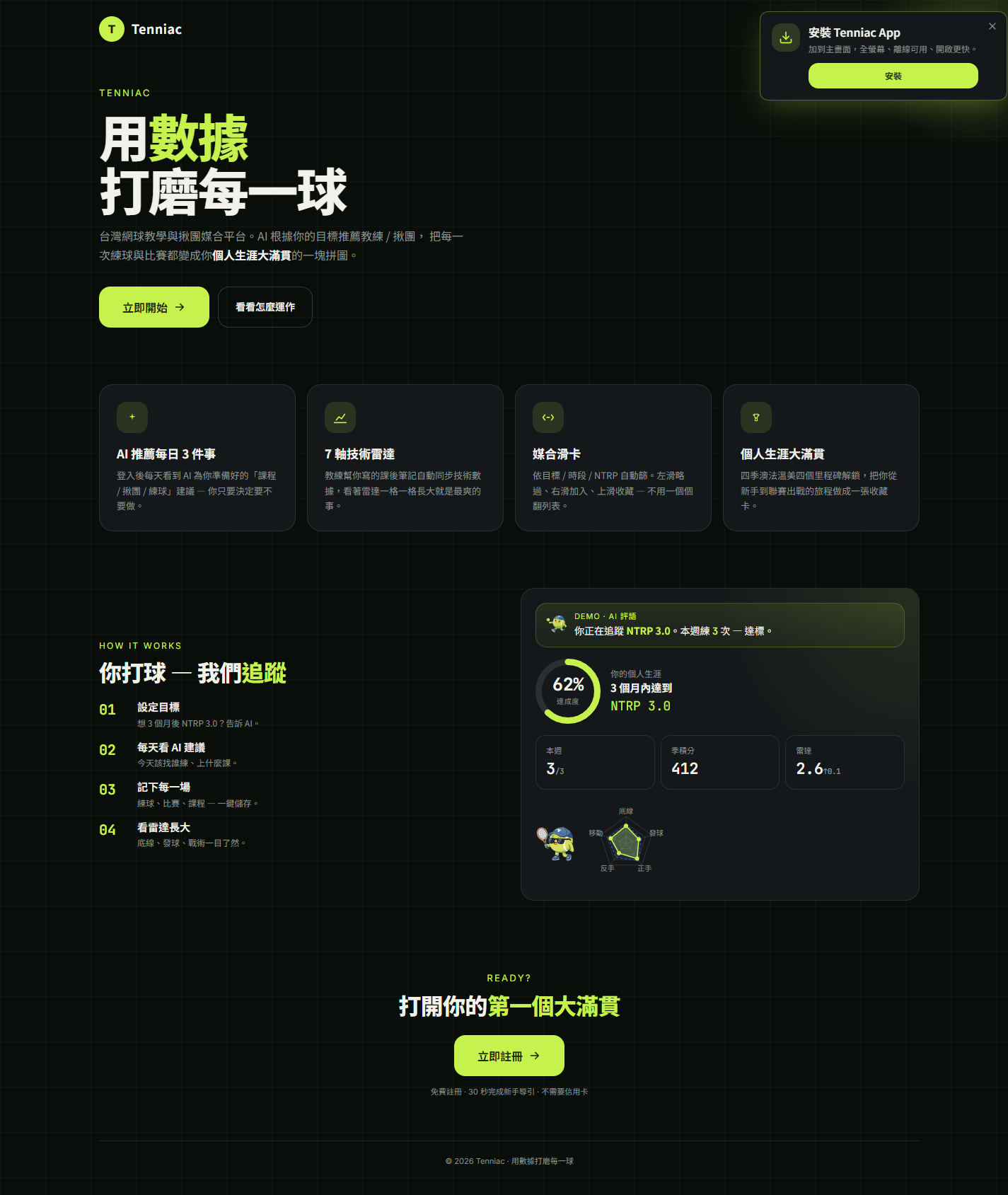
"Sharpen every shot with data." Every practice session and every match, turned into data. A 4-role PWA (player/coach/academy/admin) + AI recommendations + 7-axis skill radar + swipe-card matchmaking + seasonal points + PAYUNi subscriptions + Web Push notifications. The full story of a player's personal career Grand Slam.
- Client
- Tenniac (網球愛客)
- Industry
- Sport / community
- Service
- Custom web & apps
- Led by
- Johnny Yang
What we delivered.
- User roles
- 4 (player/coach/academy/admin, one person can hold several)
- App mode
- PWA + Web Push + Service Worker
- Onboarding
- 5 steps (including live AI recommendations of real coaches and group games)
- Payments
- PAYUNi pre-authorised subscription billing
- Iteration cadence
- v1 launch → v2 with 5-step AI-recommendation onboarding
01What the client actually needed
Tenniac (網球愛客) is a new Taiwanese brand for tennis coaching and group-play matchmaking (tenniac.brightstream.com.tw). After looking at the tennis apps on the market, local and international, the client reached one conclusion:
"They're all doing 'find a game'. Nobody is doing 'career'. What I want is the data story of a tennis player's whole journey, from beginner to the Grand Slam in their own head."
That is a product positioning call, not a feature spec. They came to Brightstream for a partner who could actually build that positioning.
02Why we took this project
The competitive landscape in tennis:
- Overseas: Playtomic (court booking), SwingVision (AI shot analysis), PlayYourCourt (coach matching)
- Taiwan: a handful of find-a-game / find-a-coach apps, mostly template builds, with no long-term growth elements
Tenniac's read was right: nobody designs the player's growth journey as the product's skeleton. Most apps treat matchmaking as a one-off action. The action ends, and nothing follows. But tennis players care about "I moved my NTRP from 2.5 to 3.0 in six months", "Where do I rank in this season's league", "Which badges have I earned".
We took it for two reasons. The know-how in this vertical is a long-term asset for us (it transfers sideways from tennis to other sports). And this "PWA + Web Push + subscriptions + multiple storage buckets" stack works for other community-driven products too.
03What we delivered
1. Building the positioning: the "personal career Grand Slam" story
The slogan "Sharpen every shot with data" runs through the whole site.
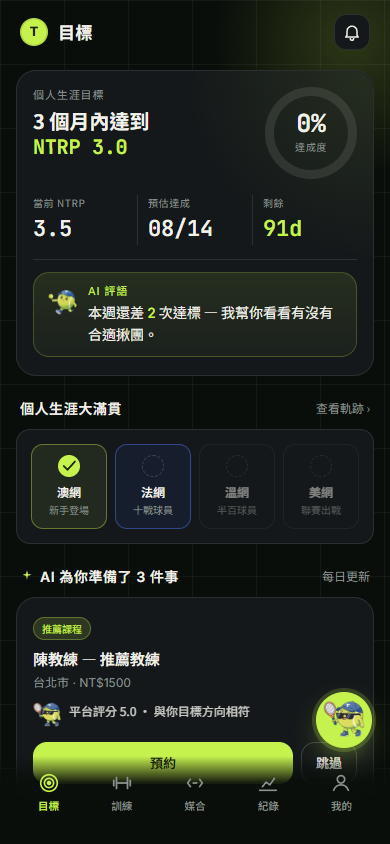
The home screen is the "Goals" tab: AI's 3 things for today + a goal progress ring + a career Grand Slam progress bar + this week's stats. Not the "recent activity feed" every find-a-game app ships with. Instead: "what you should do today to move your goal forward."
All 5 bottom tabs follow the "player journey" framework:
- Goals (AI recommendation home)
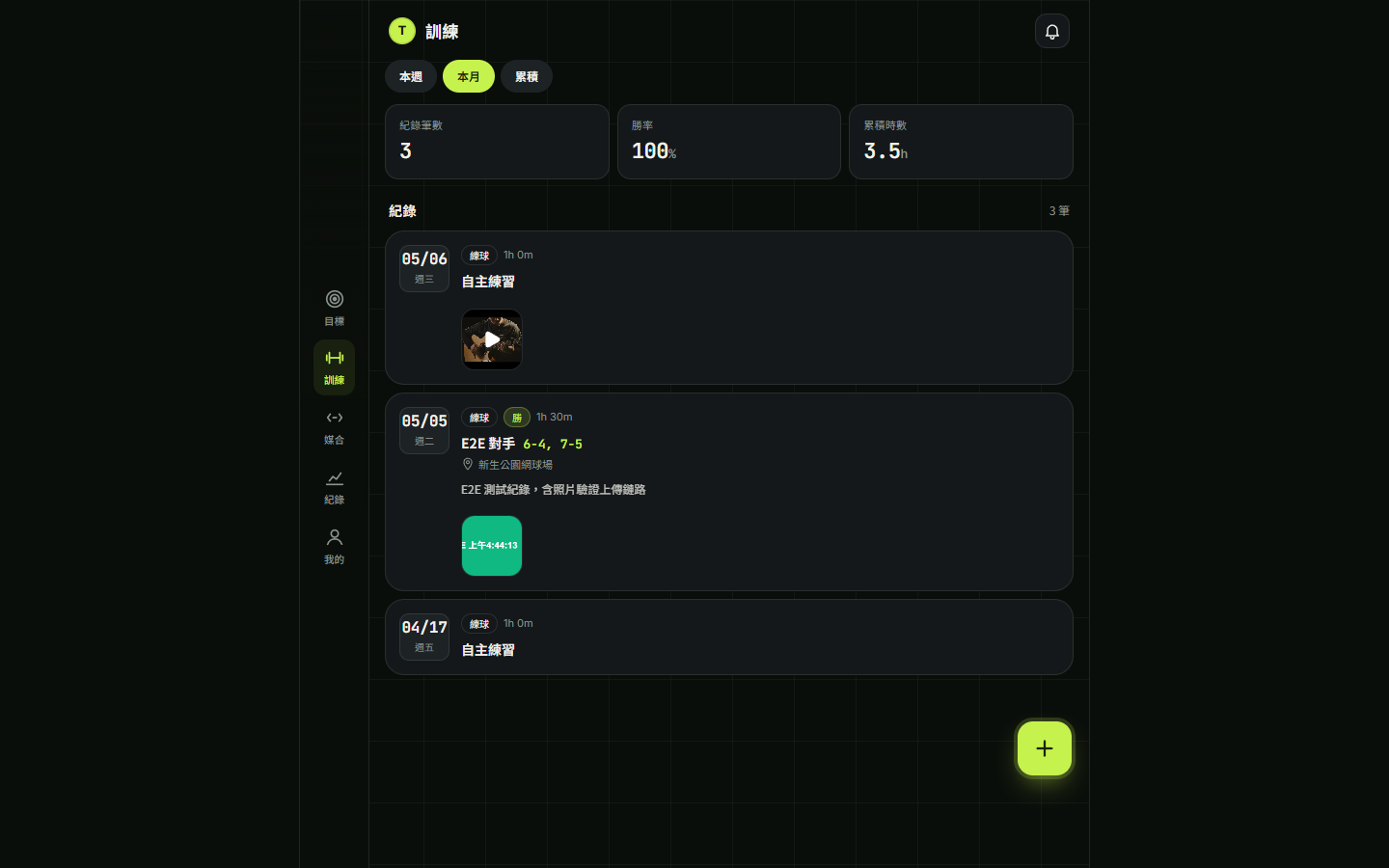
- Training (practice / match logs + rally counter + media upload)
- Match (swipe cards to find coaches and group games)
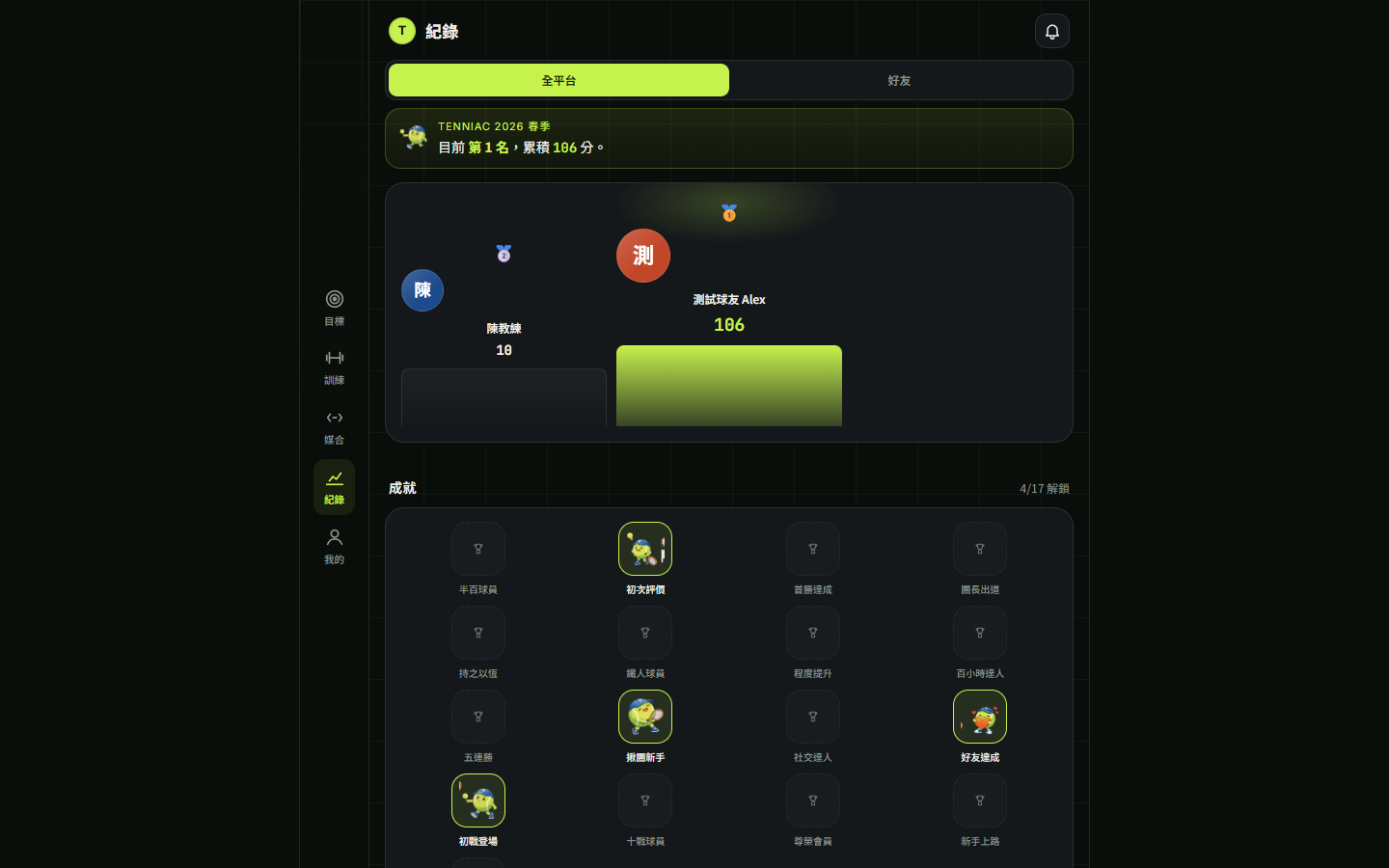
- Records (seasonal points leaderboard + Podium + achievement badges)
- Me (switch between personal + coach dashboard + academy dashboard + admin dashboard)
2. 4 roles, one account
A tennis coach can still join group games as a player and review other coaches. That's how people actually use it. So we built the 4 roles (player / coach / academy / admin) as role switching inside one auth session, not 4 separate apps.
- Player: the core 5 tabs
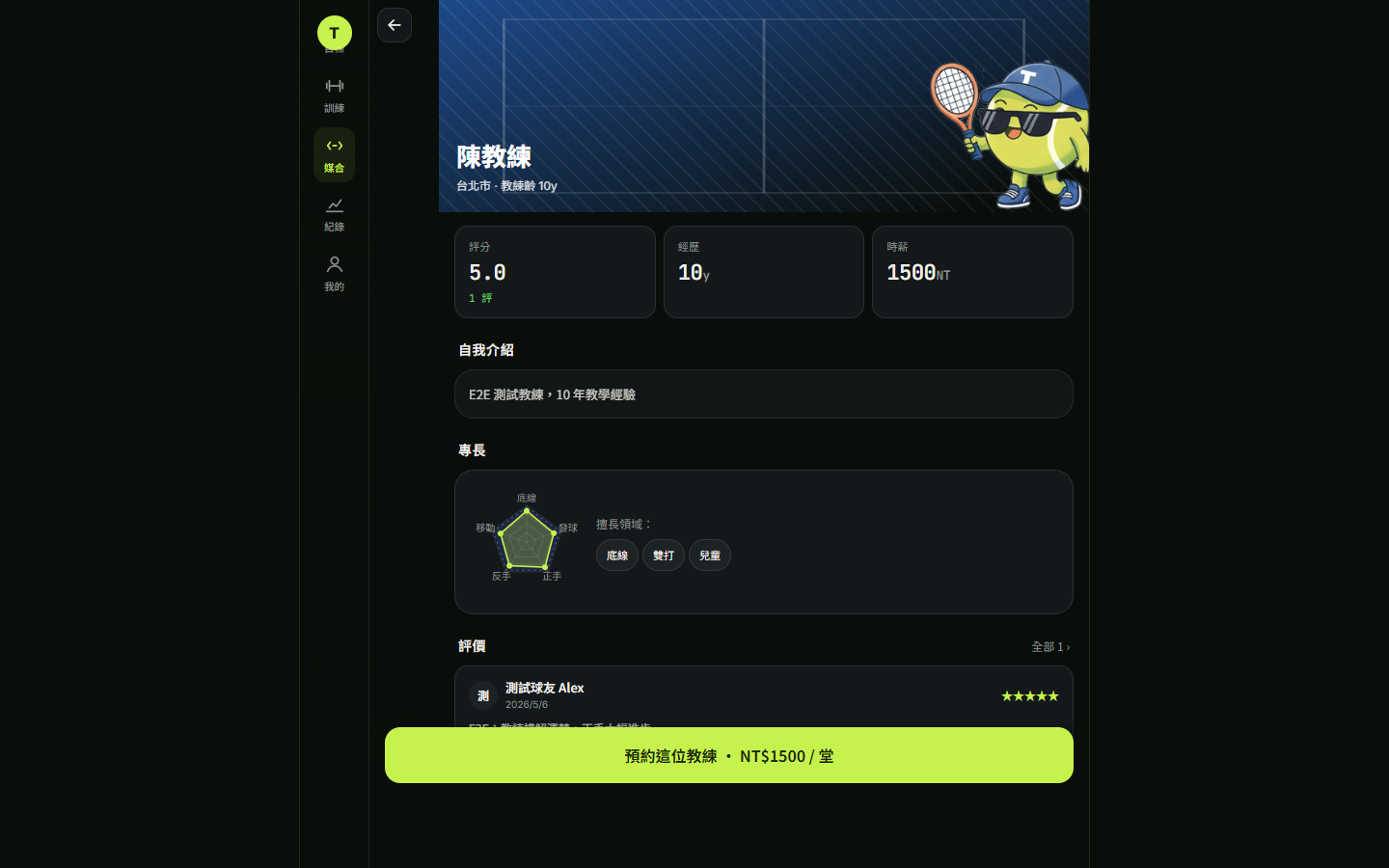
- Coach: coach dashboard (entered from "Me") — lesson management, student management, post-lesson notes
- Academy: academy dashboard — its coaching team, the academy's public page
- Admin: platform governance + moderation + report handling + data monitoring
3. 5-step onboarding (live AI recommendations)
Step 5 is not "form complete". It pulls real recommended coaches and group games on the spot, based on the goal entered in the first 4 steps (NTRP 3.0 / a one-year league) + location. The AI explains "why we're recommending this coach to you" in chat bubbles.
This converts 10 times better than "welcome message + explore page".
4. Full PWA + Web Push implementation
- PWA: players add it to their iOS / Android home screen and it works like a native app. No App Store review
- Web Push notifications: the full server-side + client-side push chain (a player taps a notification and lands on the right page within 1 second)
- Caching strategy: guarantees RLS-protected data never leaks across users, and version updates take effect immediately
This PWA can be added to the iOS / Android home screen as a near-native app, with full push notifications and no store listing.
5. 3 storage buckets + automatic orphan-file cleanup
| Bucket | Privacy | Written by | Read by |
|---|---|---|---|
| practice-media | Private | Player (owner) | Player (owner) |
| lesson-media | Private | Coach / student | That lesson's coach + student |
| review-photos | Public | Reviewer | Anyone |
Paired with daily automatic cleanup of orphaned files and database trigger sync. Over time, no junk files pile up eating storage cost.
6. PAYUNi subscriptions (pre-authorised recurring billing)
Member subscriptions run on PAYUNi (a Taiwanese payment gateway):
payuni-create-subscriptioncreates the subscription (frontend redirects to PAYUNi)payuni-cancel-subscriptionuser cancellationpayuni-notifyserver-to-server webhook (verify_jwt = false, because PAYUNi doesn't send a Supabase JWT)
All encryption logic goes through the shared _shared/payuni.ts module.
04How we work
Tenniac is a "new brand + big ambition + mid-sized budget" client. What this kind of client fears most is the bottomless pit of "the requirements changed again".
Our approach:
- Lock down the product positioning first: the first DESIGN_BRIEF listed design elements in three groups: "keep / add / won't do". Aesthetic calls like "how to abstract tennis elements" and "the logo uses the seam curve, not a literal ball" were settled up front, so we didn't redo the visuals over and over later
- The 5-step onboarding came later: after launch we found "users come in but don't know what to do". We proposed building the 5-step onboarding (with AI recommendations) into v2. It made a clear difference
- DESIGN_BRIEF v2 (Phase 2): we took real data from v1 after launch and updated the brief. This is the opposite of "waiting for the client to send requirements". We proposed the improvements ourselves
05Why this project is worth writing up
Tenniac doesn't prove "we can build a PWA". It proves "we can translate a client's vague vision into a buildable product skeleton".
"From beginner to career Grand Slam" is not something you can write as IF/ELSE. What we did:
- Broke that sentence into 5 tabs, 4 roles, 5-step onboarding, a 7-axis radar, seasonal points, achievement badges
- Built it as a PWA (it sits on the player's phone like an app, no store review)
- Connected it to subscriptions (so the business model works)
- Built Web Push (push notifications are the lifeline of community-driven products)
This way of thinking transfers to other clients that are "new brand + data story + community-driven".
In the tennis vertical, there are global players like Tennis Hub and Playtomic. But they all do the same thing: find a game, book a court. What I wanted was the data story of a player's whole journey, from beginner to their own personal career Grand Slam. Nobody does that. Brightstream understood the difference. So from day one they designed long-term growth elements into the product's skeleton: 'personal career Grand Slam', '7-axis skill radar', 'seasonal points leaderboard', 'achievement badges'. They didn't just copy an existing app.