Fluids Group
An industrial measurement and control group founded in 1994. From the brand design system and complete bilingual Figma designs to an 11-module custom-built back office and an AI customer service RAG knowledge base, one team, end to end. For industrial B2B, that level of completeness is rare.
- Client
- Fluids Group
- Industry
- Industrial / manufacturing
- Service
- Custom web & apps
- Led by
- Johnny Yang
What we delivered.
- Client feedback
- Fixed within 24 hours
- Website
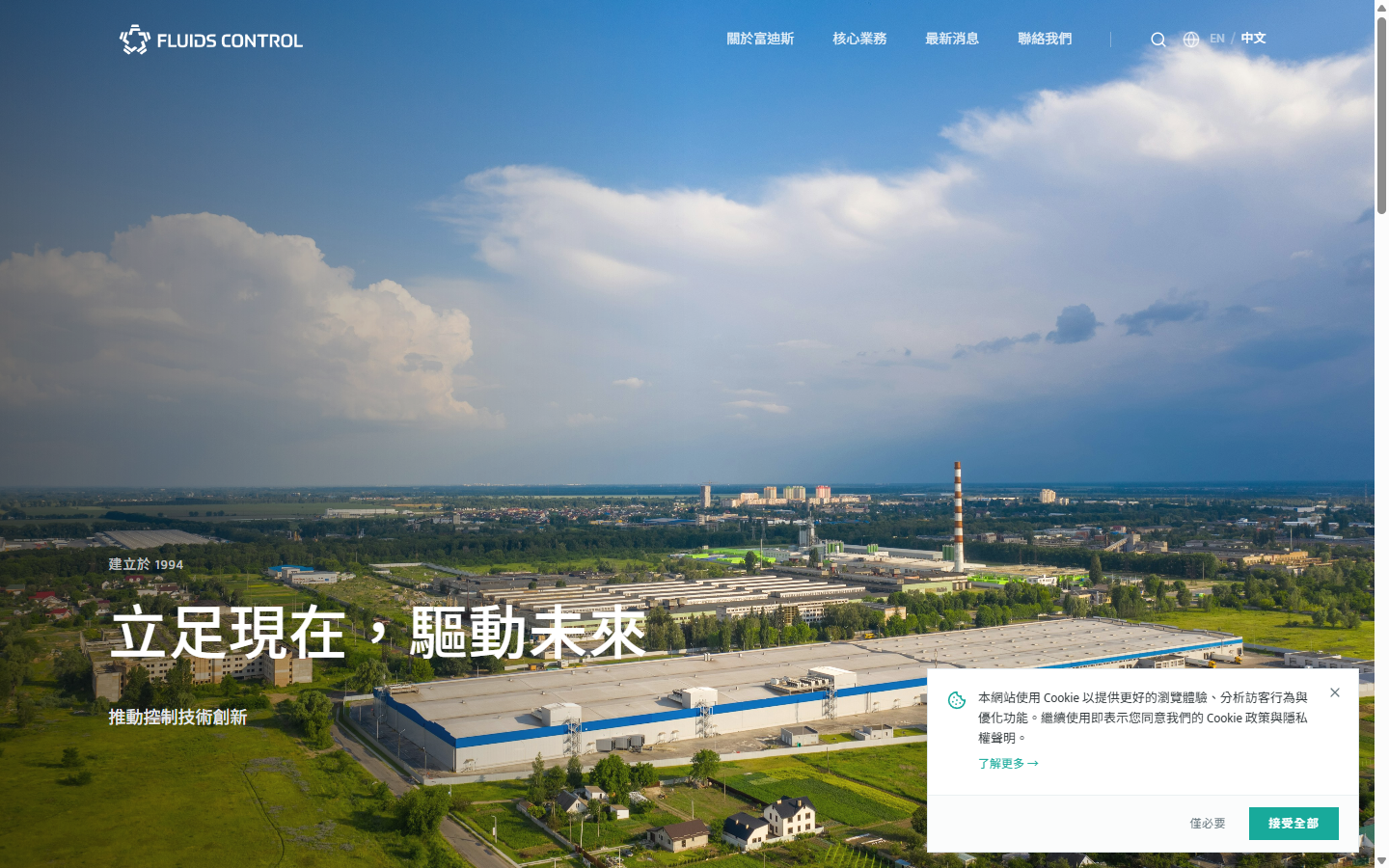
- 11 pages, Chinese/English bilingual
- Back office
- 11 content management modules
- AI customer service
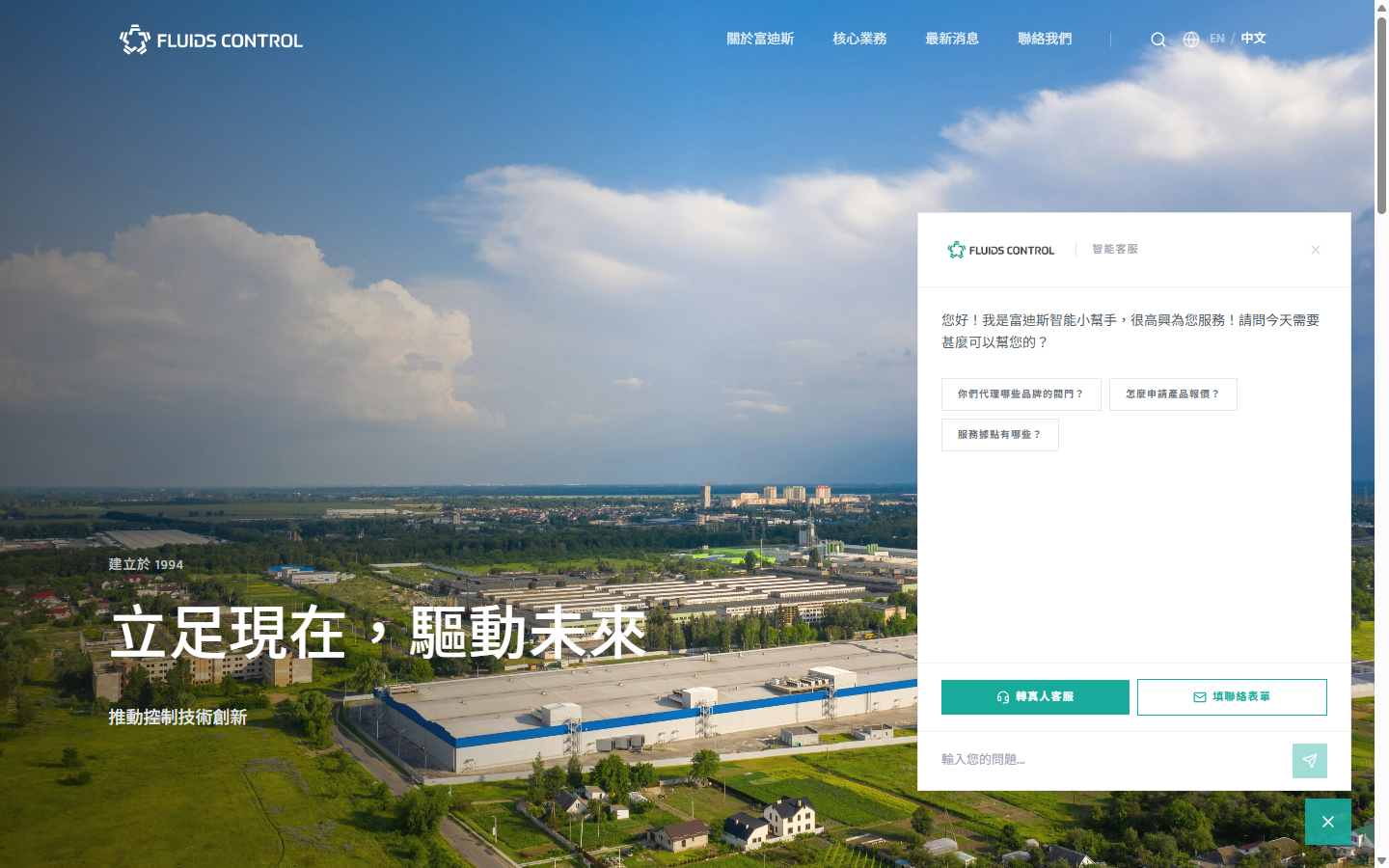
- Knowledge base that answers from company data
01Why this project is worth writing up
In early 2026 Fluids Group came to us to rebuild their brand website. What we delivered was not just "the website, coded." It ran from the brand type scale system, the design language, and complete bilingual Figma designs (Visual Language System v2.0 "Silent Confidence", released 2026-03-27) to an 11-module custom-built back office + AI customer service RAG. One team, end to end.
For industrial B2B, that level of completeness is rare. Most industrial groups either outsource the visuals to a design studio and then hire a separate engineering firm to build it (the two halves never connect), or go to a chain website company and get a template (the brand loses all its personality). Fluids Group took a third path: a small team that ties design judgment and engineering delivery together.
02How we look at a "high-end international industrial brand website"
Fluids Group is a genuinely international brand. They represent global control instrument manufacturers at the level of BADGER METER and Emerson, and their customers are purchasing decision-makers at engineering firms and large manufacturers. Their website can't just "look premium." It also has to be:
- International: Chinese/English dual-path design (not Chinese translated into English; both languages have to do justice to the brand on the page)
- High-end: every spacing, type size, and color detail holds up to cross-border B2B standards
- Precise: product specs, manufacturer information, and technical parameters cannot contain a single typo (a buyer who spots a typo stops trusting you)
- Trustworthy: founded in 1994, over 30 years of track record, upstream and downstream relationships, version history and content updates all need to be visible
These four things set our standard for the project. From the outside, Fluids Group needed "a nice bilingual website." From the inside, they needed:
- A brand type scale system that can last 10 years (not the "pick an English font, pair it with a Chinese font" level)
- A CMS that lets non-engineers edit the copy themselves (including brand story, milestones, contact info: layouts with no ready-made template)
- A product catalog that lets sales colleagues add newly represented brands themselves (manufacturer fields like BADGER METER and Emerson are dynamic)
- An AI customer service that visitors can actually get answers from (not a widget shell)
- A back-office interface that whoever takes over in the future can still understand
If we only did nice visuals, within six months the client either comes back paying us a monthly fee to change text, or the website freezes at launch day. That is a liability for the brand. For an international brand, even more so.
03What we delivered
1. Brand design system "Silent Confidence"
We drew the design system ourselves, line by line. Not the "take the client's Figma file and build from it" level.
Visual Language System v2.0 includes:
- 5 typography tiers (T1-T5), 16 classes in total (
.t1-ato.t5-meta) - Two type scale systems designed to coexist: T-System (main implementation system) + Named tokens (semantic layer)
- Dual-path type scale compression for Chinese and English:
>36px ×0.65/≤36px ×0.80/ body ×0.88, via a:root[lang="zh"]override. One CSS file, correct in both languages - Font strategy: Instrument Sans variable font (Latin, self-hosted woff2, wdth+wght axes + 4 named instances) + Noto Sans TC (Chinese), one font stack with the browser falling back per character
- Complete space / color / rule tokens: spacing, color palette (including MUTED / GHOST neutral layers), layout rules
Why this granular? Because Chinese headings set at English type sizes look "too big and too heavy," and English set at Chinese sizes looks "too small and too loose." Most bilingual sites cut corners with "one type scale for both languages," and the Chinese version ends up dragged down by the English one. We couldn't let Fluids Group's brand assets be undermined by a detail like that.
2. Complete bilingual Figma designs (11 frames)
Once the design system was defined, we drew Chinese and English versions of all 11 front-end pages in Figma (released 2026-03-27): Home, About Us, Core Business, Products, Product Detail, Services, Service Detail, News, Article Detail, Contact Us, Partners.
Mobile is aligned too. Global components (navigation bar, footer, AI customer service widget, contact modal) are all managed centrally in the design system.
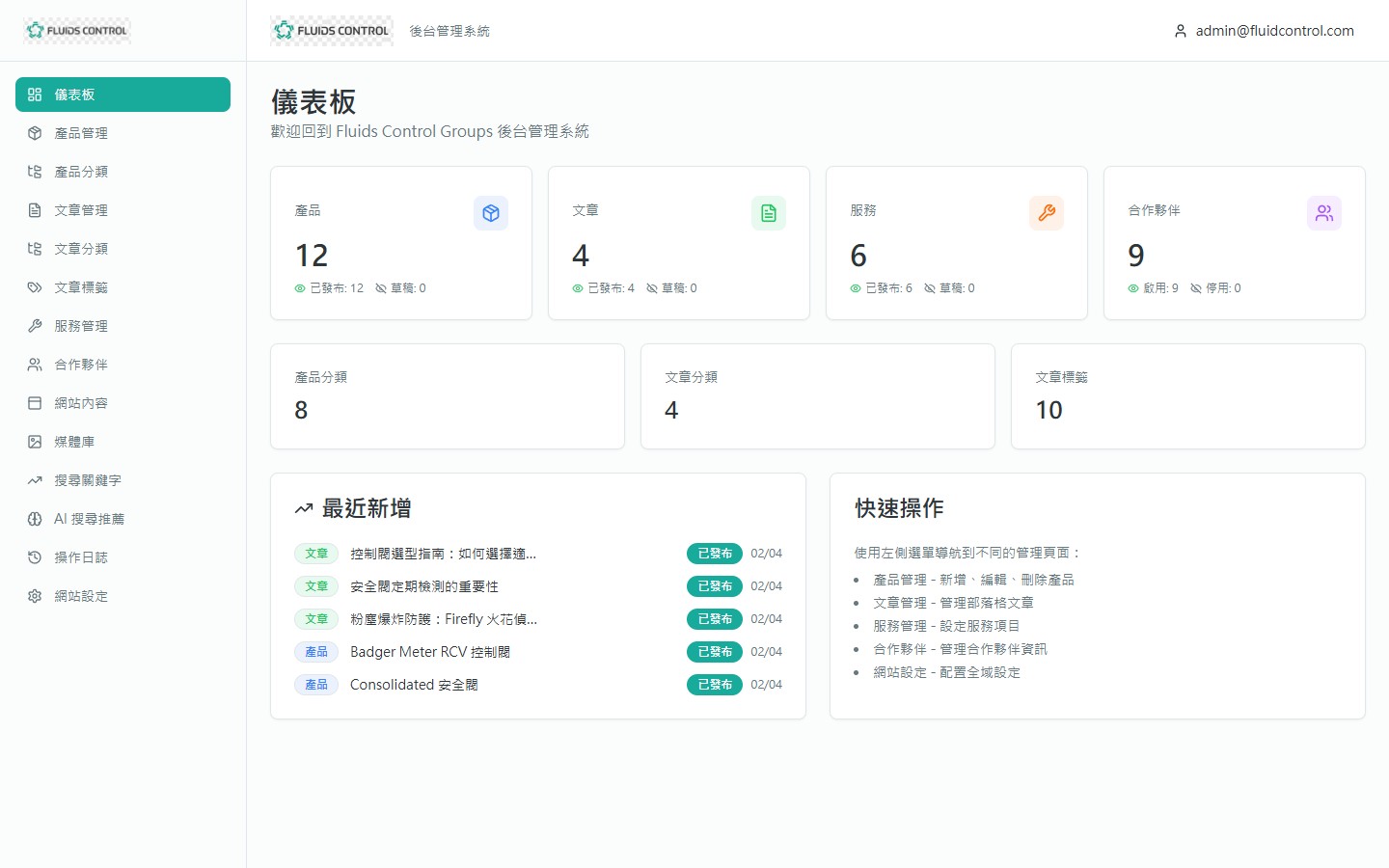
3. 11-module custom-built CMS
The back office is not a template. Each module is designed around how Fluids Group actually works:
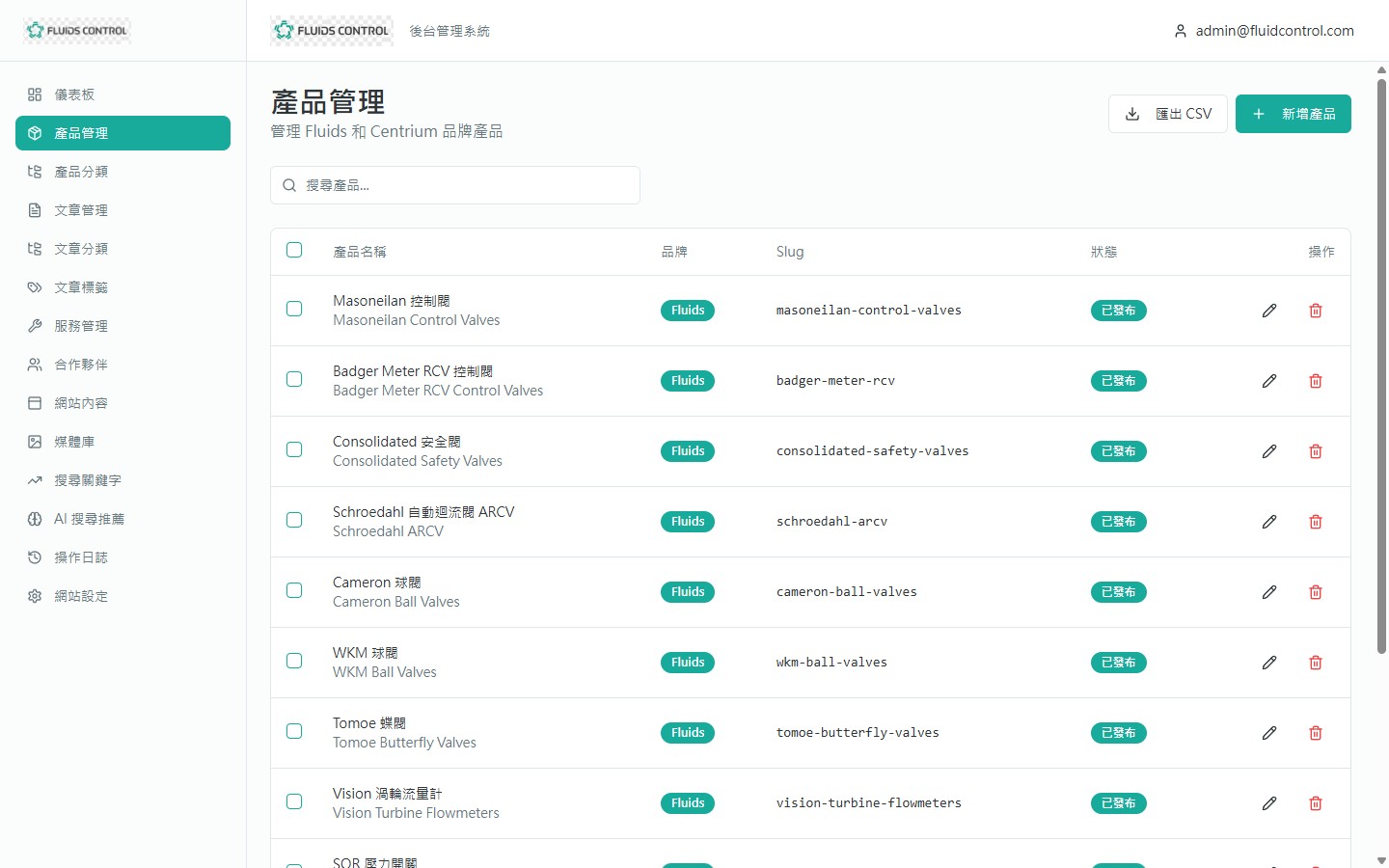
- Product management: basic info + manufacturer (separate Manufacturer field) + category + specs + features + gallery + SEO + version history + scheduled publishing + Datasheet PDF upload
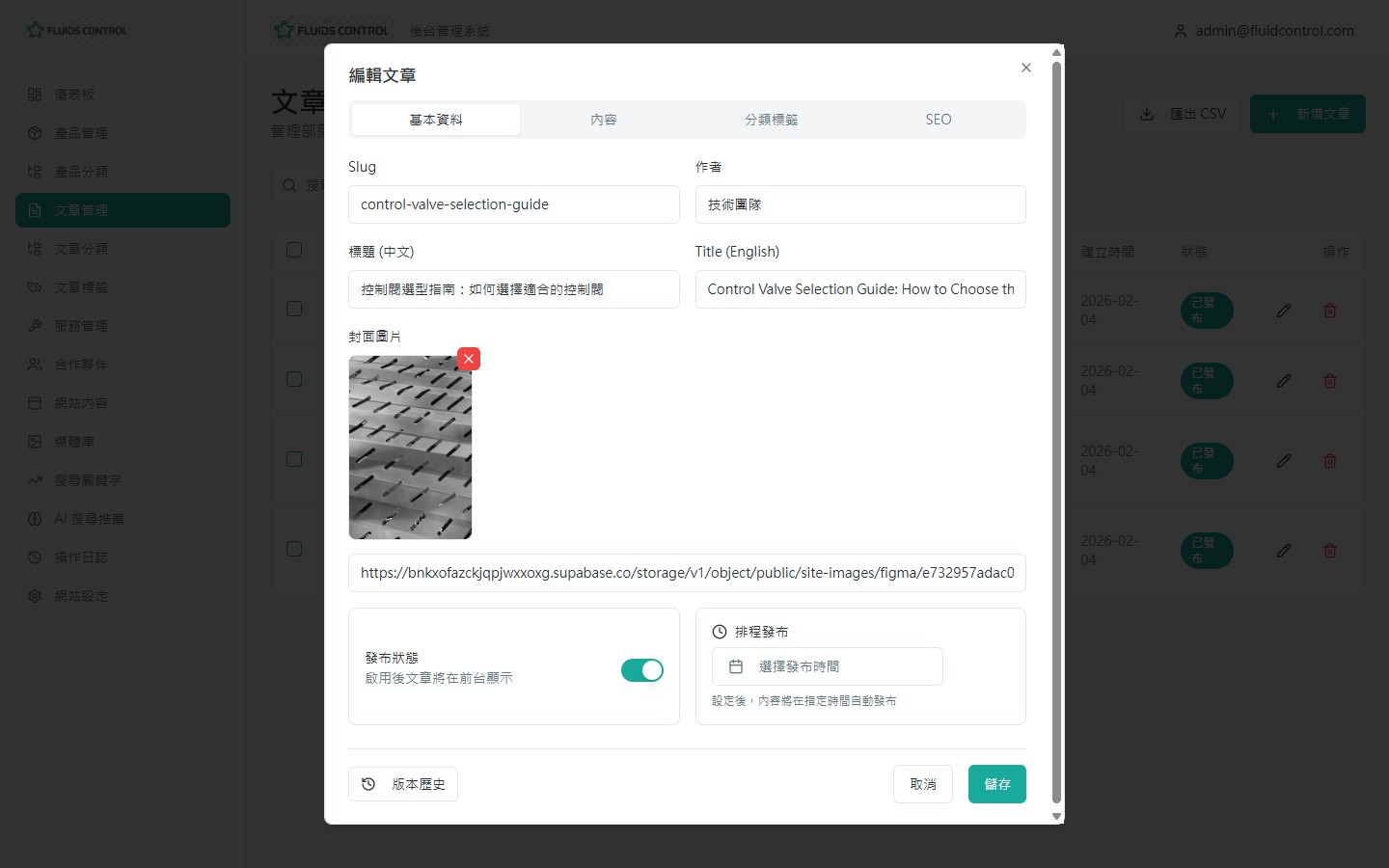
- Article management: category tags (with AI auto-suggestions) + WYSIWYG editor + SEO + scheduling
- Service management: includes service process steps (for B2B engineering sales to use in proposals)
- Partners: logo + description + link
- Site content CMS: 11 sections (brand story, company profile, milestones, contact info…). Every field has a "plain-language label" (not program names like
heading / content1), a hint box at the top shows "which part of the front end this page maps to," and a search bar lets you type "brand story" and jump straight to that field - Media library / activity log / site settings / SEO meta / AI search suggestions
The core belief behind this back office: every field is understandable, and you know which part of the front end it maps to. It doesn't need the most features. The interface must be the least off-putting.
3. A real AI customer service (not a UI shell)
We've seen too many "AI customer service" setups that are just a chat widget wrapped around GPT. This one isn't.
Architecture:
Back office uploads PDF/FAQ → chatbot-ingest Edge Function
   ↓
Split into chunks (500 tokens) → compute embeddings (OpenAI text-embedding-3-small)
   ↓
pgvector knowledge base
   ↓
Visitor asks a question → chatbot-chat Edge Function → embed → vector search top-K
   ↓
LLM generates answer + cites sources → display
   ↓
chatbot_conversations conversation log
   ↓
Back-office dashboard: conversations today / Top 10 frequent questions / resolution rate / human handoff rate / full conversations readable
DB layer: 4 new tables (including the pgvector extension) + 3 Edge Functions (chatbot-ingest / chatbot-chat / sitemap) + a back-office document management page + a conversation analytics dashboard.
That is what custom-built AI customer service means.
04How we work: the client asked us to see it all the way through
Fluids Group said it plainly from the start. They didn't want a website where changing one word after launch means calling an engineer. They didn't want it split into "design on one contract, front-end build on another." They didn't want a patchwork where "the token expires in six months and the chatbot dies." They wanted one team to see it all the way through.
To us, that's the sign of a good client. It's also a stress test: does our 100% custom-built promise actually hold.
Early after launch, the client's PM went through the back office and sent back three issues:
- Couldn't find where to edit text content (company profile, brand story)
- Couldn't find a "brand" field when adding a product
- The news editor toolbar (bold, paragraphs) did nothing when clicked
The first one, we admit, was a UI that wasn't intuitive enough. We fixed it that same morning: every field got a "plain-language label" (not program names like heading / content1), a hint box at the top showing "which part of the front end this page maps to," and a search bar where typing "brand story" jumps to that field.
The second was a schema design problem underneath. In the DB, "brand" was an internal category (Fluids / Centrium). Manufacturer brand names (BADGER METER and so on) had no separate field. We admit we missed it, and we added a separate Manufacturer field (migration add_product_manufacturer).
The third was a real bug. The editor was originally in Markdown mode, and the front end didn't render it to HTML. That same day we rebuilt it entirely as WYSIWYG (bold / italic / H2/H3 / lists / quotes / links / images / Word paste auto-cleans formatting / Undo Redo).
All three fixed within 24 hours, with walkthrough demos. This was the first test of the 100% custom-built promise: the client's pain points don't sit in a backlog for two weeks. Fixed the same day, delivered the same day.
05What we did in parallel: proactively auditing "visible on the front end, empty on the back end"
Fixing the client's three issues wasn't enough. At the same time we ran an internal audit: walked through the entire front end and back end side by side and found every gap where something "is visible but isn't connected":
- Contact form: you can fill it in on the front end, but the submit handler is empty, so messages disappear
- Newsletter signup: the input is there, but clicking the button does nothing
- Product inquiry: redirects to contact, but contact isn't implemented
- Product Datasheet PDF: no download link on the front end, no upload field in the back office
- Sitemap.xml / robots.txt: not done (hurts SEO)
All 12 gaps laid out, ranked by severity, estimated in hours, and closed in priority order within 1-2 weeks. That is our standard for "delivering a high-end website."
06Why I took this project
I didn't take this project because "we know industrial B2B." I took it because we understand business, we have a team, and we're willing to spend the time to understand any industry in depth.
That's a judgment built up over years of projects: even within the same industry, every company is different. Templates don't fit. In medical aesthetics, chain brands and single clinics run on completely different logic. In printing, paper product OEM and design printing are worlds apart in what they need. In media, B2C traffic sites and B2B knowledge sites play two entirely different games. Industry is a rough category. What actually decides whether we can deliver is "did we spend the time to understand this particular company."
I took the Fluids Group project for three reasons:
- The client is one of the few industrial groups that genuinely takes "brand assets" seriously (from 1994 to today, over 30 years of track record worth doing properly)
- The client asked us to "see it all the way through," which is exactly how we work (design → engineering → AI → back office → maintenance, no handoffs between stages)
- AI customer service RAG is something all our other clients ask about, and Fluids Group was willing to be among the first to get this stack running end to end. That's know-how we carry into future projects
The conclusion: this project doesn't prove "we're good at industrial websites." It proves that "our method for high-end brand websites + 100% custom-built work holds across industries."
07Technical details (for fellow engineers)
- Front end: Vite + React + shadcn/ui + Tailwind
- Back end: Supabase (PostgreSQL + Auth + Storage + Edge Functions + pgvector)
- Design: Visual Language System v2.0 "Silent Confidence" (16 typography tokens + bilingual type scale compression)
- Fonts: Instrument Sans variable font (Latin) + Noto Sans TC (Chinese)
- AI customer service: 5 new DB tables + pgvector + 3 Edge Functions (ingest / chat / sitemap)
- Editor: WYSIWYG (H2/H3, bullets, numbering, quotes, links, images, Undo/Redo, Word/Docs paste auto-cleans formatting)
- Multilingual: Chinese/English aligned (every form has a zh/en tab)
- i18n type scale:
:root[lang="zh"]override (no second CSS file) - CMS: 11 front-end pages, 11 back-office modules, version history + scheduled publishing + activity log
We didn't want it split up. Not design on one contract, the front-end build on another, and a chatbot that expires in six months with nobody looking after it. We wanted one team to see it all the way through. Brightstream is one of the few partners that can deliver everything end to end: brand design, type scale system, Figma designs, back-office CMS, and AI customer service RAG.