
80 LINE messages a day, nobody answering, and a NT$2,000,000 order gone: how a refrigeration equipment maker got every message answered within 5 minutes
A refrigeration equipment maker's LINE account got 50–80 messages a day, and nobody was responsible for them. Phase one got every message answered within 5 minutes. Phase two pushed cold-storage equipment alerts to the on-duty technician's LINE within one minute.
- Client
- 亞冠冷凍機械 (Yaguan Refrigeration Machinery): LINE on-duty message routing + refrigeration equipment alerts pushed to technicians' LINE
- Industry
- Industrial / manufacturing
- Service
- LINE integration
- Led by
- Johnny Yang
What changed.
All figures are the client's own internal data, published with their consent. Sources and measurement methods are available on request.
01A NT$2,000,000 order went to a competitor
亞冠冷凍機械 (Yaguan Refrigeration Machinery) makes industrial refrigeration equipment. Its sales team has more than 10 people. When clients have questions, they send them to the company's LINE Official Account. About 50 to 80 a day.
The problem: nobody was responsible for those messages. Everyone assumed someone else would reply. Clients waited 3 hours on average before anyone responded. One major client, with orders worth more than NT$2,000,000, waited too long and went to a competitor.
02The problem wasn't too few people. It was no one being "the one responsible"
After looking at their situation, my first call was this: hiring more customer service staff would not fix it. The sales reps were already there. Everyone could see the messages. What was missing was one very simple rule: right now, whose message is this.
So in phase one we built nothing complicated with AI. We did three things: schedule who is on duty each day, send messages straight to the person on duty, and escalate when nobody replies.
03Phase one: every LINE message gets picked up
- Automatic scheduling: on-duty sales reps are scheduled automatically by day and by week, with days off and leave built in.
- Messages go straight to the on-duty rep's personal LINE: no need to keep watching the Official Account dashboard. A client sends a message, the on-duty rep's phone rings.
- No reply means a reminder. Still no reply means escalation: if a message goes unanswered past the time limit, the system reminds the rep first, then notifies their manager.
- Full conversation history: every conversation stays with the company. When a rep leaves, the client relationship doesn't leave with them.
After launch, customer service efficiency went up 150%, response speed went up 75%, and revenue grew 23%. Missed messages went from more than 10 a week to close to zero.
04Phase two: when a cold room has a problem, the technician knows within a minute
Once customer service was stable, 亞冠 came back to us for a second job.
The refrigeration equipment 亞冠 sells is installed in clients' cold-storage warehouses and watched by an on-site monitoring computer. Before, when equipment raised an alert, the message went to a different messaging app. Technicians had to keep one more app open, and it was hard to check who had received an alert and who hadn't. When a cold room's temperature goes wrong, finding out a few hours late can mean the whole room of goods gets written off.
In phase two, we connected equipment alerts to the same LINE Official Account:
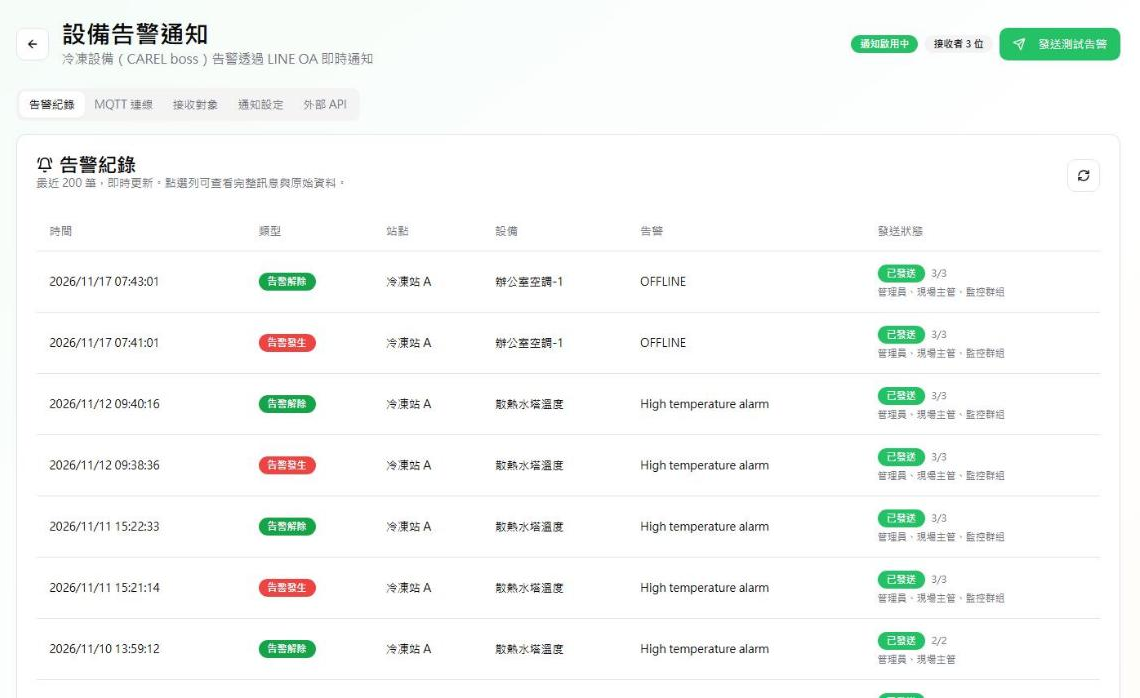
- When equipment raises an alert, LINE notifies the on-duty technician or the technical group within one minute. When things return to normal, a second "alert cleared" message goes out, stating how long the problem lasted.
- It also notifies you when the monitoring computer loses its network connection or power. The alert isn't the scary part. The scary part is "we thought everything was fine, but we just weren't receiving anything."
- Alert names people can actually read: Simplified Chinese on the equipment is automatically converted to Traditional Chinese (the script used in Taiwan), and English alert names nobody understands can be renamed in the dashboard to whatever the site crew normally calls them.
- Routing by site and by equipment: alerts from each plant go to the right group. Not everyone gets woken up.
- Every alert is logged: who it was sent to, who received it, who didn't, and why not. All on one page.
Two cold-storage sites with 54 units in total are connected so far. They are now running the contract's acceptance test: "7 consecutive days of normal operation."
05Why both phases live inside LINE
Customer service and equipment alerts use the same LINE Official Account and the same on-duty roster. Sales reps and technicians don't install any extra app, so they can use it on day one. When the owner wants to check which message or which alert went to whom, it's all in the same dashboard.
This is what Brightstream keeps doing: build the company's systems inside LINE, so employees don't have to learn new software.
06My take
When many owners run into "missed messages", the first thing they think of is hiring people or buying a big customer service system. 亞冠's case shows that just using a system to settle "who is responsible" often solves most of the problem. Once phase one is stable, extend into equipment and the shop floor, and every step has results you can see.

