

“Everything ran smoothly when we were thirty people. Why am I fighting fires every day now that we're eighty?” The owners who say this have usually grown revenue. More customers, more products, more locations. But more and more of their day goes to asking people, waiting on people, and cleaning up other people's messes.
I'm Johnny Yang, founder of Brightstream Technology in Taiwan. I've led teams building systems for seven years, across more than 252 projects in 32+ industries. Before that, I was an owner myself. Six industries, NT$7,000,000 lost in three years. The most expensive lesson was "keep adding headcount": every time we got stuck, I hired one more person. The number of people I had to watch kept growing. The problems did not shrink.
My answer: as a company grows from 30 to 200 people, its systems usually have to pass four stages, and the signal at each one is the same: people can no longer hold it together. Stage one is around 30 people. The owner can't see every order anymore, and data has to move out of everyone's Excel files and LINE chats into one place. Stage two is around 50 to 80 people. Middle managers appear, and permissions and approvals have to be written into the system instead of living in the owner's memory. Stage three is around 100 people. Things start falling between departments, and orders, shipping, invoicing, and collections have to be connected into one line. Stage four is around 150 to 200 people. Multiple companies, multiple locations, multiple warehouses. The owner needs consolidated numbers, and the system itself needs someone to look after it long term. At every stage, the right move is not to buy one system for 200 people all at once. It's to let the system grow piece by piece, adding the next piece before the company hits the next stage.
Hiring when you're stuck is the fastest fix, and the most expensive
First, I'm on your side. When a company gets stuck, hiring is the obvious fix. No process changes. No convincing everyone to learn something new. The new person can start tomorrow. At thirty people, hiring one more assistant to keep the data organized really does work.
That's exactly what I did, for years. The problem is that every person hired to "plug a hole" becomes a human interface. Their job is moving A's data to B, relaying the owner's instructions to the floor, merging three Excel files into one. That work produces nothing by itself, but it makes the company more and more dependent on specific people. When they take leave, the process stops. When they quit, the rules walk out with them.
The bigger problem is time. The more people and the more years your data is scattered across, the harder it is to clean up later. Cleaning up customer data at 30 people might take a week or two. At 100 people, the departments, versions, and exceptions involved multiply several times over. So "we'll do the system once we're bigger" is usually the choice that makes the system most expensive. I wrote about why adding headcount keeps making the hole bigger, from my own experience, in Hiring is the most expensive mistake: the lesson that cost me NT$7,000,000.
One caveat: the headcounts for each stage below are rough positions I've seen in the field, not precise thresholds. A wholesaler with lots of SKUs might hit stage two at forty people. A project-based company with simple processes might still be at stage one at 120. Watch the signals, not the headcount.
Four stages: the signals and what to add at each
For each of the four stages, I'll cover three things: what the signal is, what to add, and what can wait.
Stage one (around 30 people): the owner can't see every order anymore
When the company is small, the owner touches every order and every payment, so they remember everything. At around thirty people, there are more orders than the owner can follow, and they start having to ask: "Did that customer's goods ship?" "Did we collect that payment from last month?"
The clearest signal at this stage: the same data exists in several versions. Sales has its own customer list, accounting has its own receivables sheet, the warehouse has its own inventory sheet. The three don't match, and every month someone spends time reconciling them.
There's only one thing to add here: keep data in one place. Not a huge system. Just move the core data, customers, orders, inventory, out of everyone's Excel and LINE into one place, so everyone looks at the same copy. This is also why I started building systems in the first place: data in one place, not one copy in the system, one in Excel, and one in LINE.
What can wait at this stage: a full finance module, complex reports, multi-company structure. For where Excel breaks down, see the five signals in How many people can you run a company on Excel?
Stage two (around 50 to 80 people): managers appear, and the rules have to move from the owner's head into the system
At this size, a layer of managers grows in the middle: a sales manager, a warehouse manager, an accounting manager. The owner no longer manages everyone directly. They manage the managers. This is when the problem becomes "rules."
The signal: everything waits on the owner's signature, nobody can say clearly who's allowed to change a price, and each new manager does things their own way. The owner thinks they've delegated, but everyone still comes to them for everything, because the rules exist only in the owner's head, not written down anywhere.
What to add: permissions, approvals, and standard processes written into the system. Who can see costs, who can change prices, who has to sign above what amount. Once those rules are in the system, they don't depend on the owner remembering every time or being there every time. I wrote up a permission structure you can use directly in How to set system permissions: who sees costs, who changes prices.
What can wait at this stage: full integration across departments. Get each department's own rules sorted out first, so the next stage can connect them.
Stage three (around 100 people): things start falling between departments
At around 100 people, departments have clear roles, and each might have its own tools. The problem isn't inside departments. It's between them. Sales takes an order and the warehouse doesn't know. The goods ship and accounting doesn't know to issue the invoice. The customer pays and sales is still chasing them.
The signal: every week there's an "I thought you knew" incident, and every time it takes a meeting to find where it fell through. When the owner wants a complete set of operating numbers, they wait for several departments to compile their own, then for someone to merge them.
What to add: connect everything from order to cash into one line. When sales opens an order, the warehouse, shipping, and accounting all see the same record, and when each station finishes, the next one knows automatically. The numbers the owner needs come straight off that line, with no one hired to compile them.
What can wait at this stage: group structure, multi-company consolidation. Get the line running smoothly inside one company first, then talk about crossing companies.
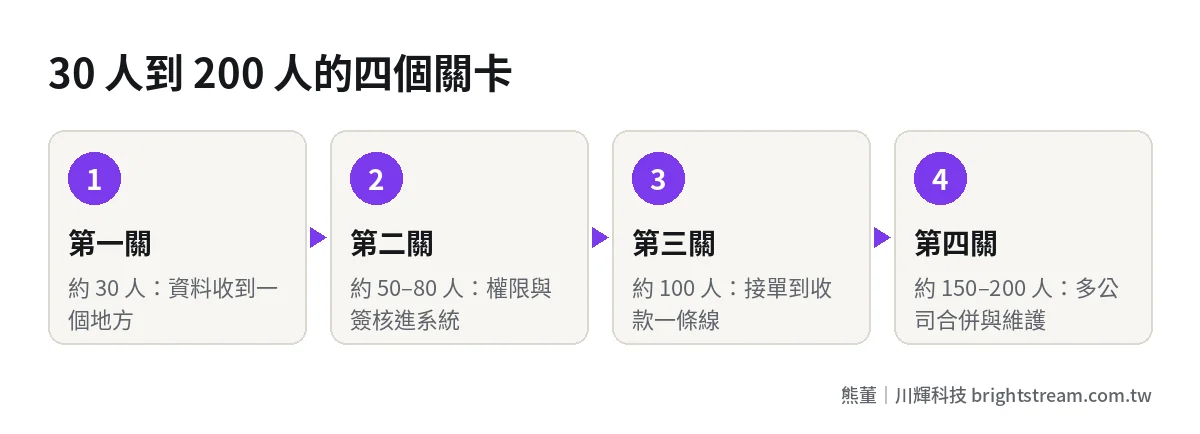
Stage four (around 150 to 200 people): multiple companies, multiple locations, and the system itself needs looking after
At this size, many companies are no longer one company. Maybe a new entity was set up for a different line of business. Maybe there are several locations or warehouses. The owner no longer wants one company's numbers. They want everything together.
There are two signals. First, every month, seeing consolidated books and inventory means someone pulling reports from several companies and stitching them together. Second, the system is now the company's lifeline. A day of downtime affects over a hundred people, yet nobody can say clearly who's responsible when it fails, where the backups are, or how long recovery takes.
Two things to add here: a consolidated view across companies and locations, and long-term care for the system. The first gives the owner the whole group on one screen. The second makes sure this now-grown system has someone maintaining, updating, and backing it up. For how to see books and inventory together, see Several companies in a group: how to see books and inventory together.
The four stages in one table
Put side by side, it's clearer what each stage needs and what it doesn't need yet.
| Stage | Approx. headcount | Clearest signal | What to add | What can wait |
|---|---|---|---|---|
| Stage one | Around 30 | Same data in several versions | Core data in one place | Full finance module, multi-company |
| Stage two | 50 to 80 | Everything waits on the owner's signature | Permissions, approvals, standard processes | Full integration across departments |
| Stage three | Around 100 | "I thought you knew" between departments | Order to cash connected into one line | Group structure, cross-company |
| Stage four | 150 to 200 | Consolidated numbers stitched together by hand | Multi-company consolidated view, long-term maintenance | Features built in advance for future expansion |
The last column of this table matters as much as the fourth. Every stage has things that look like they should be done but don't need to be yet. The line I say to owners most often is "don't build this," and it applies especially to growth: a system built too early often no longer fits by the time you actually need it.
Why is buying a system for 200 people all at once actually dangerous?
At this point some owners think: we're definitely going to grow, so why not buy a system for 200 people now and avoid changing it at every stage?
That makes sense. Switching systems really does hurt, and nobody wants to do it twice. But buying too big carries three risks. First, most features go unused in year one, yet you pay for them, learn them, and configure them up front. Second, processes get locked in before they've settled, and when the company reaches the next stage, you find the original setup doesn't match how you work now. Third, the system is too complex, the floor finds it hard to use, everyone drifts back to Excel, and it ends up as a very expensive ornament.
The better approach is to let the system grow piece by piece. Get the data structure right from the start and leave room to expand, but build only the features this stage needs. At each next stage, add the next piece. This is also why we build with modules: the industries and projects we've done accumulate into ready-made modules, faster than writing from scratch and a better fit than packaged software. Whatever stage the company reaches, you plug in that piece.
I covered how mid-size companies should choose between packaged, cloud, and custom-built in more detail in The ERP dividing line for 50–200 person companies. Read it alongside this one.
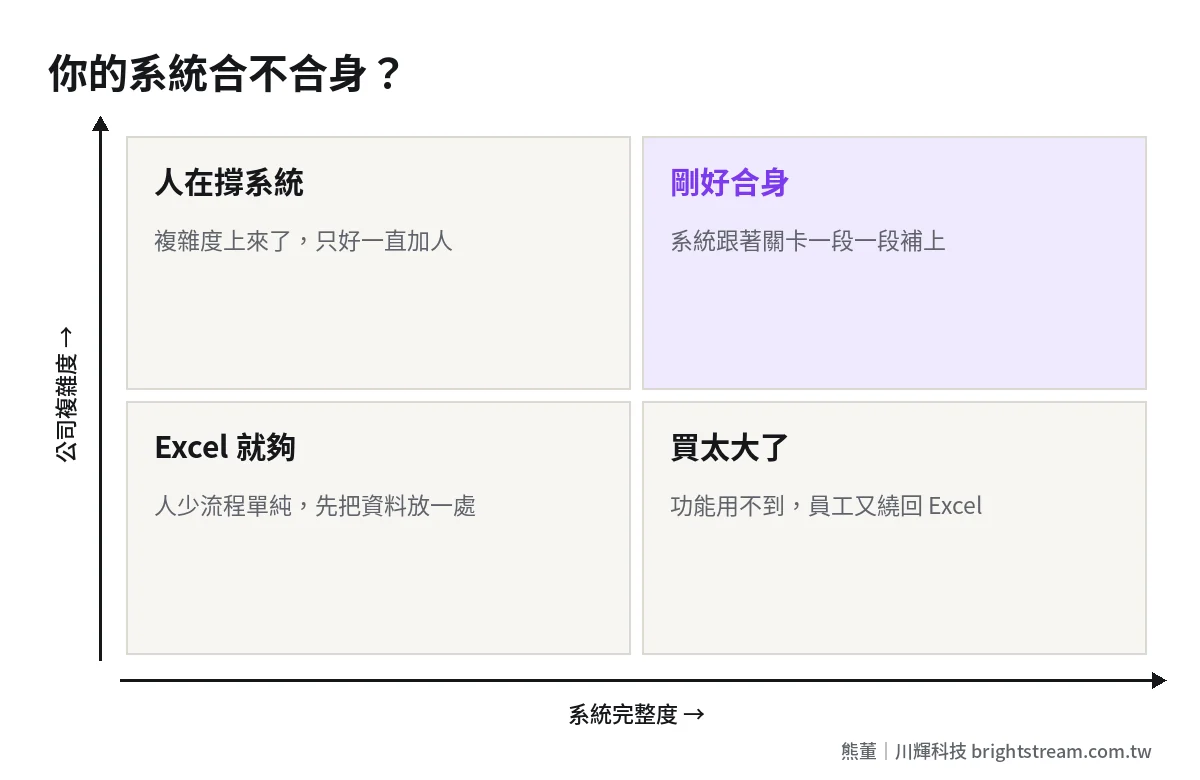
At every stage, the owner's own role has to change too
As the system grows, the way the owner works has to change too. Plenty of companies add the system and still get stuck, because the owner is running a 100-person company the way they ran it at thirty.
At stage one, the owner goes from "the person who remembers everything" to "the person who keeps data in one place." No more relying on their own memory. They require everyone to put data in the same place, and they look only at that copy themselves.
At stage two, the owner goes from "the person who makes every decision" to "the person who sets the rules." Rules written clearly and put into the system, managers deciding on their own within those rules, and the owner handling only the exceptions outside them.
At stage three, the owner goes from "the firefighter" to "the person watching the whole line." No more chasing things one by one. They look at which station on the line keeps jamming and fix that station.
At stage four, the owner goes from "the person watching one company" to "the person watching the whole picture and the risks." They look at consolidated numbers, and they make sure someone is looking after the system that holds the whole company up.
Which stage are you at? Three questions to decide for yourself
You don't need a consultant to find out where you're stuck. Ask yourself three questions:
- What's the question I ask most often every day? "Did we collect that payment?" is stage one. "Who's allowed to decide this?" is stage two. "Why didn't anyone tell the warehouse?" is stage three. "How much are we actually making, all together?" is stage four.
- The last time something went wrong because information didn't get through, where did it happen? Inside one department, or between departments, or between companies? Where it went wrong is the stage you're at.
- If your most senior employee quit tomorrow, what would stop? Whatever stops is the rule that most needs to go into the system right now.
If the three answers point to different stages, go with the earliest one. The stages come in order: if data isn't in one place, setting permissions won't help. If permissions aren't sorted out, connecting departments will be a mess. Get through the earlier stage first, and the later ones go smoothly.
FAQ
At what headcount should a company implement an ERP?
I don't recommend deciding by headcount. Watch the signals. Same data in several versions, everything waiting on the owner's signature, things constantly falling between departments: when those show up, it's time to let a system take over. Some companies need it at forty people. Some don't need a full ERP even at 100.
Can we start with a small system and expand it later?
Yes, and that's usually what I recommend. Two conditions: keep data in one place from the start, and leave room in the data structure to expand. Do those two, and at each stage you just add a new piece instead of starting over.
We're opening a new location or a new company. What should the system be ready for first?
First decide which data is shared and which stays separate. For example, whether customers and products are shared, and whether the books are kept separate. Make that decision and the system setup becomes clear. Skip it and rush to copy a setup, and seeing consolidated numbers later will be very painful.
When is the best time to switch systems?
Before you hit the next stage, and away from peak season and year-end closing. If you wait until you're fighting fires every day, nobody has time to cooperate and the new system struggles to go live. The best time is when you start feeling "we're about to break," not when you've already broken.
Conclusion: the system grows with the company, not after it
As the company grows, the system has to grow with it. The signal at every stage is that people can't hold it together anymore, and what to add at every stage is only the next piece, not everything at once. Adding it before you hit the next stage, instead of rescuing things after, saves more than money. It saves your own time.
If you're not sure which stage your company is stuck at, bring the one thing that gives you the biggest headache and book a free 30-minute diagnostic with me.