

A lot of people ask me: can one person really run a company?
Yes. But let me be clear first. A "one-person company" doesn't mean you do everything yourself. That's not a company. That's a self-employed person working themselves into the ground. A real one-person company is you making the decisions alone, then using a full set of systems and tools to scale one person's output up to the size of a team.
This isn't theory. I'm Johnny Yang. Seven years of back-to-back startups. My teams have delivered 252+ projects across 32+ industries. I've run a company with a lot of people. It lost NT$7,000,000 in three years, and in the end I shut the team down and started over alone. Everything I learned this round is in the 5 things below.
1. Get clear first: you're selling your judgment, not your hours
The easiest way for a one-person company to die is treating yourself as a "cheaper employee": taking gigs, getting paid per job, trading time for money. Time has a ceiling. On that path you will never out-earn a company with 10 people.
Ask it a different way: why would a client hire you instead of just using AI themselves?
Right now, anyone can build features. For someone who knows how to use AI, the bar for hacking together a tool is absurdly low. So what you can sell isn't "I can build this." It's "I know how this has to be done to actually work." That judgment, those trade-offs, the weight that only comes from having stepped in the holes yourself. AI can't generate that. That is a one-person company's moat. If you want to go deeper on this, read "When AI is everywhere, what's left for humans to do?" next.
2. Hand every repetitive task to a system
One person's time is the most expensive resource you have. So anything repetitive, predictable, and rule-based should be automated from day one: first-line customer replies, content distribution, data cleanup.
My own method is to ask one question about every piece of repetitive work: "Can the rules for this be written down?" If they can, it goes to a process and AI. If they can't (meaning it needs judgment), I keep it. For a one-person company to survive, the ratio is roughly this: you spend 20% of your time on the judgment only you can make, and the system runs the other 80%.
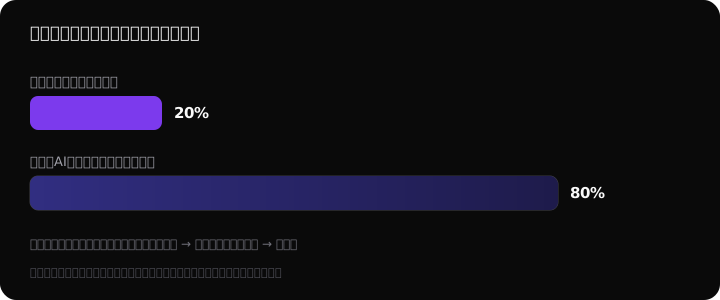
By the way, this "if the rules can be written down, systematize it" test isn't only for one-person companies. Owners whose companies have grown past a dozen people and are still forcing it with Excel are stuck on the same problem. I broke down the signs that it's about to blow up in "How many people can you run a company on Excel before it breaks?"
3. Build a channel people come back to before you talk product
The most common beginner mistake is heads-down building a product, then finding out after it's done that nobody knows who you are.
Reverse the order. First grow a channel that keeps coming back to you: a podcast, an Instagram account, a newsletter. The value of a channel is that every time you have something new, you can legitimately reach the same group of people again. The product can grow slowly. But without a channel, you have to find customers from scratch every time, and that is the most expensive cost there is. As for where the money comes from once the channel is built, "How do you make money from short-form video?" has my full take on that path.
4. Give enough for free that it feels great, and people will trust the paid version
I'm willing to share for free. That's not me being zen about it. It's strategy. If what you give away for free genuinely helps someone, even if it only saves them half an hour or makes them a bit more money, then they'll believe the judgment in your "paid version" is worth buying.
The free version can't be a crippled version. Free has to let people get all the way through once and feel how good it is. Paid sells "volume, automation, and my judgment, kept up to date." Build trust first. Revenue is the natural result of trust, not the entry fee.
5. Give yourself a number, and adjust toward it every day
In a one-person company there's no boss watching you. Your biggest enemy is "feeling busy." Busy is not progress.
So I set myself a clear cash-flow target, and then every post, every video, every draft, I ask: does this push me toward that number? If it doesn't, it gets cut, no matter how much I enjoy it. Only with a number do you know whether today moved you forward or kept you spinning in place.
Frequently asked questions
Q: Do I need to quit my job to start a one-person company? No, and I'm against quitting with nothing lined up. Things 1 and 2 (figuring out what judgment you're selling, systematizing the repetitive work) can be tested after work. Once your channel has people coming back to you, then talk about going full-time. When your cash flow breaks, your judgment breaks with it.
Q: How big can a one-person company get? Bigger than most people think. Tools and AI have raised the ceiling on one person's output across the board. The point isn't headcount. It's whether your system can take over 80% of the routine work. When you find even the system can't keep up, that's the point where you decide whether to hire your first person.
Q: Can someone with zero technical skills run a one-person company? Yes, but the order is different. First connect your processes using off-the-shelf tools (the bar is lower than you think), and keep the "judgment" for yourself. When you truly need a custom-built system, bring a process that already runs smoothly to the vendor. You'll spend less than half of what you would by "building the system first and figuring out the process later."
Can one person plus a full set of AI actually make it work?
That's exactly the experiment I'm running now. I want to prove that one person + a full AI system can build a founder brand and keep it profitable.
The whole process, every trade-off, every failure and fix, goes into my podcast 熊董不上班 (roughly "Johnny Yang Doesn't Go to Work"), updated every Wednesday. If your company is already more than one person and you're stuck on processes and systems, the library of 252+ projects has approaches from your industry. Or book a free 30-minute diagnostic. Pick a time slot online, and I'll help you find the part you should fix first.