
"We're distributors. What scares us isn't having no orders. It's taking an order and then finding out it loses money." The sales rep is at the customer's office and asks the warehouse on LINE: "Do we still have that model?" The warehouse replies: "Yes." Except the stock is in the other warehouse, so moving it adds two days and an extra freight run. That batch was bought in US dollars last quarter, and the exchange rate then is a fair way off from today's. And the price the rep quoted is the special price this customer got last year. None of the three is a big mistake on its own. Together, the margin on this order is gone.
I'm Johnny Yang, founder of Brightstream Technology in Taiwan. I've led my team building systems for seven years, across more than 252 projects in 32+ industries, including channel businesses like equipment distribution and cross-border B2B. Owners of these companies know their products and customers well. Where they get stuck is this: the business is clearly running, but nobody can say what the margin is.
The short answer: in a distributor's system, multiple prices, multiple warehouses and multiple currencies cannot be managed separately, because they all show up on every single order. Price determines revenue. The warehouse determines whether you can ship and how much freight it costs. Currency determines cost. What the system has to do is show the sales rep three things at the moment of quotation: which price applies to this customer, which warehouse can actually ship (after subtracting what's already promised to others), and the cost calculated at the actual purchase exchange rate. When you evaluate a distributor ERP, don't look at whether "multi-currency" and "multi-warehouse" are ticked on a feature list. Take your most complicated order, have the vendor walk it from quotation to shipment, and see whether those three numbers appear on the same screen at the same moment.
Distributor margin quietly leaks in three places
The distributor business model is simple: buy from the manufacturer or upstream supplier, add the value of your channel, service and inventory, and sell downstream. Margins are thin to begin with, so every small leak eats directly into profit.
The three most common leaks:
- Price leaks. The rep quotes the wrong price, uses an expired special price, or forgets that a customer's price was already adjusted. Or, to win the deal, the rep verbally agrees to a discount that never gets recorded in the system, and accounting only finds out when issuing the invoice.
- Warehouse leaks. The system shows stock, but it's already promised to another customer, or it's in another warehouse, at sea, or on loan at a customer's site for display. The rep takes the order, then the warehouse says it can't ship. So you rush stock in from elsewhere, pay extra freight, and maybe miss the delivery date.
- Exchange rate leaks. You buy in foreign currency and sell in NT dollars. The cost used in the quotation is based on an exchange rate from long ago, or an estimate accounting only adjusts at month end. When the rate moves, the rep has no idea the quoted price is already below cost.
What these three have in common: by the time you notice, the order is taken, the goods have shipped, and the loss has happened. So the point isn't auditing after the fact. It's letting the rep see it at the moment of quoting.
Multiple prices: turn price lists into rules, not one Excel file per customer
Many distributors manage prices like this: one list price sheet, plus a special-price Excel file for each important customer, plus a few LINE chats on the reps' phones. Once you have enough customers, nobody can say for sure what the correct price is for a given customer right now.
A better approach is to turn pricing into a handful of rules instead of hundreds of sheets. Common rules: customer tier pricing (distributor, retail, project), quantity break pricing, customer-specific contract prices with validity periods, and promotional prices with start and end dates. The system pulls the price automatically based on the rules. When a rep wants to change a price beyond a set range, a manager has to approve it, and the change is logged.
I covered the design details of customer tiers and quantity breaks in Wholesale pricing tiers: how to charge different customers different prices in the system. This post adds another angle: price can't be looked at only from the revenue side. It has to sit next to cost. The same contract price makes money when the exchange rate is favorable and may lose money when it isn't. So pricing rules need a warning attached: when a quotation drops below a certain margin, the system flags it, instead of leaving the rep to do the math.
Multiple warehouses: reps need available-to-promise, not stock on hand
This is where I most often see owners and reps get it wrong. The "inventory" the system shows is usually the quantity physically in the warehouse. What the rep needs to know is: how much can I promise this customer right now, and when will it arrive.
What's the difference between the two? Available-to-promise is roughly: current stock in each warehouse, minus quantities promised to other customers but not yet shipped, minus quantities awaiting quality inspection or out on loan, plus in-transit quantities already ordered and expected to arrive by a certain date.
| What the rep sees | What it actually means | What happens if you don't separate them |
|---|---|---|
| Total stock | Actual quantity across all warehouses | You think you have stock, but it's scattered across locations |
| Stock by warehouse | What each warehouse has right now | You don't know how long a transfer takes or what the freight costs |
| Committed | Ordered by customers but not yet shipped | The same batch gets promised to two customers |
| In transit | Ordered from the supplier but not yet in the warehouse | You don't know when the next batch arrives |
| Available-to-promise | Sellable quantity after commitments, plus in-transit | This is the number the rep should give the customer |
How to book transfers, in-transit and loaned stock across warehouses is covered in more detail in How to manage multi-warehouse inventory: booking transfers, in-transit and loaned stock. For distributors, the more important step is pushing available-to-promise straight to the rep's phone, so he can answer in front of the customer instead of messaging the warehouse on LINE.
There's another kind of warehouse many distributors don't treat as one: consignment stock sitting at customers' sites, and demo units lent to customers for trial or display. These goods aren't in your warehouse, but you still own them. If the system doesn't record them as a separate warehouse, a chunk goes missing at stocktake, and reps may treat those units as already sold. This is especially common in equipment distribution. Once enough machines are out on loan, the books stop matching.
Multiple currencies: "let accounting adjust the rate at month end" is half right
Many owners see exchange rates this way: "Buying in foreign currency is fine. Accounting adjusts at month end, and the books will balance in the end."
There's logic to that. From an accounting standpoint, adjusting the rate at month end by the rules and recognizing FX gains and losses does make the books balance. Most ERPs have multi-currency features too: you enter the foreign currency and rate on the purchase order, and the system converts it to NT dollars when booking.
But the real problem isn't whether the books balance. It's which cost the rep uses when quoting. Month-end adjustments fix the books, not the cost in the rep's head. If the cost the rep sees when quoting is a conversion from months ago, or he can't see cost at all and only sees list price, then once the rate moves, the price he quotes may already have no margin, and nobody will notice for the whole month.
So multi-currency management covers more than bookkeeping. It's three things:
- Book purchase cost at the actual exchange rate. The rate at which each batch came in should be recorded on that batch, not a monthly average or an estimate.
- Show the latest replacement cost at quotation time. If the next batch will be bought at today's rate, the quotation should reference today's cost, not only the cost of the old batch sitting in the warehouse.
- Foreign-currency quotations have an expiry date. When quoting overseas customers in foreign currency, the quotation should state a validity period and be recalculated once it expires, so you don't close a deal at the old price after the rate has moved.
For the full picture on quotation, customs declaration and exchange rates in import/export trading, see What kind of ERP does a trading company need?. That post focuses on trade workflow. This one focuses on distributor margin control.
Putting the three together: margin on a single order
Only when you put all three back on the same order do you see the difference. Below is a hypothetical calculation. The numbers are for illustration only and don't reflect any real market prices.
Say a distributor receives an order: 100 units of one model, a distributor-tier customer, and the system pulls a contract price of NT$1,000 per unit.
- A rep who looks only at price: sees the NT$1,000 contract price, the list cost sheet says NT$800 per unit, and assumes a margin of NT$200 per unit, NT$20,000 total.
- Add the warehouse: the main warehouse has only 60 units available-to-promise. The other 40 have to come from another warehouse. Assume transfer plus freight adds NT$30 per unit. Margin on those 40 drops by NT$1,200.
- Add currency: this batch was bought in foreign currency. At the actual purchase rate, cost per unit isn't NT$800 but NT$850. That's another NT$50 off per unit, NT$5,000 across 100 units.
You thought you'd make NT$20,000. You actually make a little over NT$13,000, more than 30% less. And that's one order. A rep quotes dozens, sometimes over a hundred orders a month. Each one off by a little adds up to the slice of margin the owner can't explain.
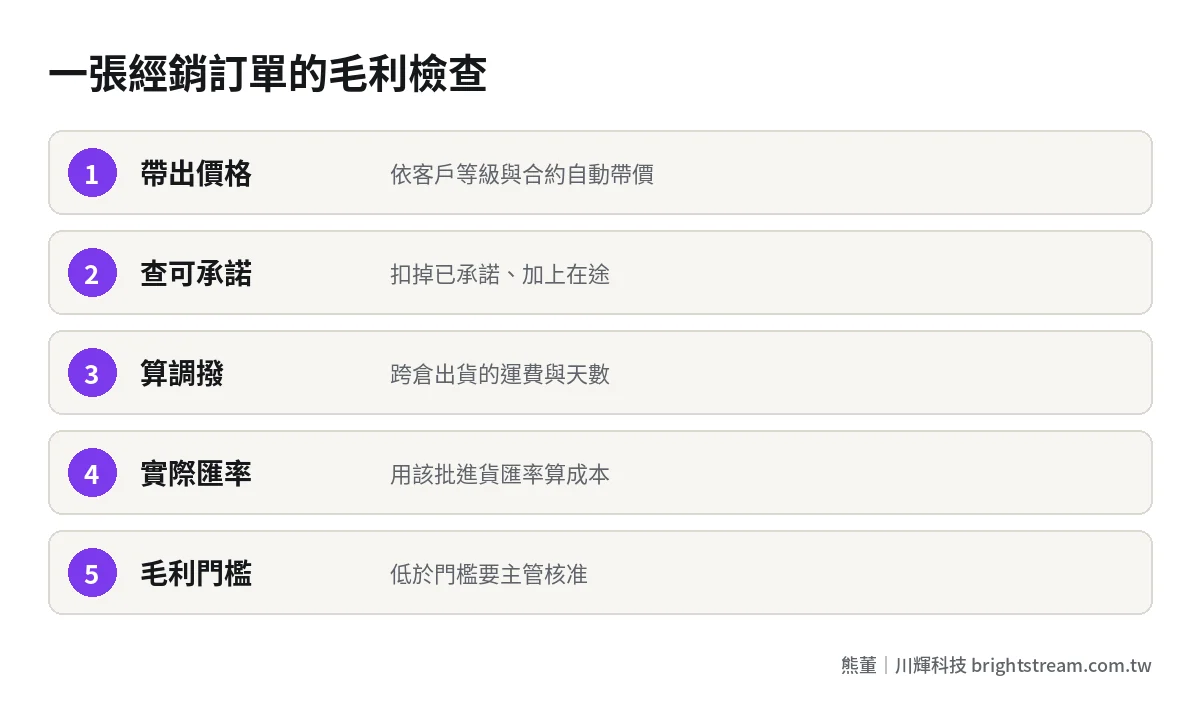
This is why I say the three can't be managed separately. Looked at separately, each one has an owner. Looked at together, nobody owns how much this order actually makes.
Seven things to test in a distributor ERP demo
Once you know what you need, you know what to look for when choosing a system. Don't let the vendor run their prepared script. Test them with your own most complicated scenarios.
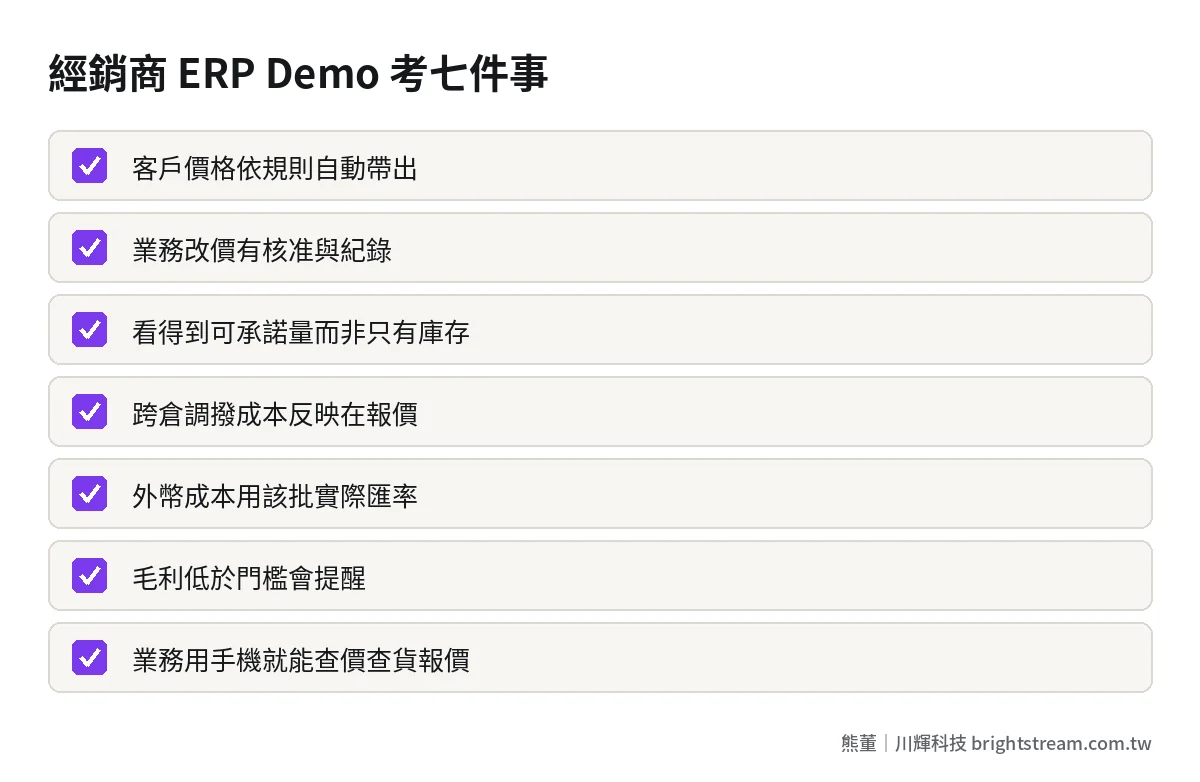
- Enter a customer and an item. Does the price come up automatically by rule, including contract price, quantity breaks and validity period?
- When a rep changes a price, is there an approval flow and a log, so you can see afterwards who changed it and why?
- Do you see available-to-promise, or only stock on hand? Are committed and in-transit quantities counted?
- When shipping across warehouses, are transfer cost and time reflected in the quotation?
- Is foreign-currency purchase cost based on that batch's actual exchange rate, or an average or estimate?
- When quotation margin falls below a threshold, does the system warn or require approval?
- Can a rep out in the field use a phone to check prices, check available-to-promise and send a quotation, without going back to the office or asking someone?
The seventh matters especially in Taiwan. Many of a distributor's downstream customers order and ask about stock over LINE. Brightstream built a system for a cross-border B2B brand that takes orders automatically through a LINE Bot, managing 1,218 products and 2,204 stores across 4 regions. For how to let downstream customers order on LINE themselves, see Distributor ordering systems: let downstream customers order on LINE themselves. For other common trick questions at demo time, What should you look for in an ERP vendor demo? lists ten.
Do the three have to be done all at once?
No, and I don't recommend it. If you launch everything at once, sales, warehouse and accounting all have to change habits at the same time, and when something breaks you can't tell which part caused it. A safer order:
Start with pricing rules. Reps use this every day and it shows results fastest. Pull the special prices scattered everywhere into rules, and wrong quotes drop right away. Next, available-to-promise, so reps stop messaging the warehouse on LINE. Exchange rate cost and margin alerts come last, because they depend on the first two having correct data. Only then is the margin number trustworthy.
Run each stage for a month or two after launch. Confirm people actually use it and the numbers reconcile, then move to the next. The total timeline may be a bit longer, but every stage stands on solid ground, and you're less likely to end up paying for something nobody uses.
Finally, budget. Brightstream's system implementation starts at NT$300,000, quoted by spec. We write a feature list first, then quote a fixed price, and bill in stages, collecting each payment only after the agreed result is running. After launch, maintenance starts at NT$20,000 per month, quoted by system size. Whoever you end up choosing, have them put the seven items above into the feature list, and test each one at acceptance.
FAQ
Does a distributor really need an ERP? Is an inventory and order system enough?
It depends on how complicated your pricing rules and warehouses are. A distributor with one warehouse, simple pricing and no imports is usually fine with a basic inventory and order system. Once you have multiple warehouses, multiple customer prices and foreign-currency purchasing, and reps keep quoting wrong prices or promising stock that can't ship, you need a system that ties price, inventory and cost together.
Which exchange rate should multi-currency cost use?
For booking, use the actual purchase rate of each batch and record it on that batch, so the books are accurate. For quoting, also reference the latest replacement cost, meaning what the next batch would cost at today's rate. For month-end rate adjustments and how to recognize FX gains and losses, follow your accountant's advice.
What do I do if reps keep quoting wrong prices?
First pull prices out of everyone's separate Excel files into a few rules, and have the system pull them automatically by customer and quantity, so reps don't look them up themselves. Price changes need an approval flow and a log, and the system should warn when quotation margin drops below a threshold. Wrong quotes drop sharply, and when there are exceptions, you can trace why.
What's the difference between available-to-promise and stock on hand?
Stock on hand is what's physically in the warehouse. Available-to-promise is what you can actually promise a new customer after subtracting what's already promised to others, awaiting inspection or out on loan, and adding expected in-transit arrivals. Reps should quote available-to-promise to customers. Otherwise it's easy to promise the same batch to two customers.
A distributor's system should tell you at quotation time whether you'll make money
A distributor's system isn't managing three separate "multiples". It's managing the moment on every order when price, warehouse and exchange rate all happen at once. Let reps see those three numbers when they quote, and margin stops draining away where nobody is looking.
If you're evaluating a system for your distribution business, or your current system handles inventory but not margin, take a look at how ERP implementation works to see how we start planning from your most complicated order.