
"We have a CRM. But honestly, it's just a more expensive contact book."
I've heard this dozens of times. The owner paid for it. Staff spent time typing into it. Now there are thousands of customer records sitting in the system. And then? Nothing.
I'm Johnny Yang. Seven years as a serial founder. My team has done 252+ projects across 32+ industries, and more than half of them came down to one question: how do customer records turn into money. This post takes apart why CRMs don't work. Conclusion first: the problem usually isn't a bad system. At least one of the three things below is true.
Cause one: you use it to record, not to predict
If your CRM looks like an address book, of course it doesn't make money.
Recording answers "who is this customer." The questions that actually turn into money are:
Who is about to buy again? Who is slipping away? Who are your top 20% VIPs? Who has been stuck at the quotation stage for 14 days and needs someone to follow up?
What these questions have in common: they all point to "what to do next." The core value of a CRM was never record-keeping. It's decisions. A CRM that actually makes money should hand you a "who to follow up with today" list every morning, instead of waiting for you to remember to go dig through it. (For how a system moves from "recording" to "making its own calls," see "What AI ERP can do for you".)
Self-check: open your CRM. If the feature you use most is "search for a customer's phone number," you're not using a CRM. You're using a phone book.
Cause two: you bought a system you can't afford to run
High-end CRMs really are powerful: precise segmentation, customer journey automation, multi-system integration, deep customization. But all of these features carry a hidden assumption: someone has to operate it.
Big companies have a marketing team feeding and tuning it every day. Your company? Maybe the accountant uses it on the side, or you, the owner, look at it at midnight. The more features a system has, the more features go unused, until the whole company feels only one thing about it: hassle.
An F1 car isn't a bad car. It's just not what you drive to buy groceries. A small business doesn't need the most powerful CRM. It needs one that's just enough: it reminds you who to follow up with, sorts customers automatically, is simple enough that staff don't resist it, and pulls in data on its own. Those four things, done well, beat anything else. (How to pick a CRM that makes you money instead of turning into an address book, I wrote up separately in "How SMEs should choose a CRM".)
Same logic as choosing an ERP, which I broke down in "Inventory system vs. ERP: understand the difference before you spend": a tool's ceiling isn't its feature list. It's whether your company can actually run it.
Cause three: the data never flows in (the most common, and the least noticed)
The CRM is downstream. Data is upstream. If your orders are in the POS, inquiries are in LINE, leads are in the salespeople's phone contacts, and closed sales are in Excel, the CRM will only ever hold the small slice someone remembered to type in. It hurts even more in ad-heavy industries like medical aesthetics: ad data lives in Meta, consultations happen in person, payment happens at the register. The three stages don't connect, so you're always guessing about the money. How to close the "ad → consultation → sale → repeat visit" loop, I covered in "What medical aesthetics clinics should think through before implementing a system".
Incomplete data can't produce any useful judgment. That's why so many companies use a CRM for a year and still end up managing customers from the owner's memory. The data in the owner's head is more complete than the system.
The most dangerous part of the upstream is "leads in the salespeople's phones": the company never really owned that data, and when the person leaves, it leaves with them. How to take it back, and how far to go without triggering staff pushback, I wrote in "Customer data scattered across employees' phones? Lesson one in turning data into an asset". The other part is LINE. Many companies run even orders and task assignments through group chats. "Three risks of running your company in LINE groups, and how to fix them" covers how to patch that upstream.
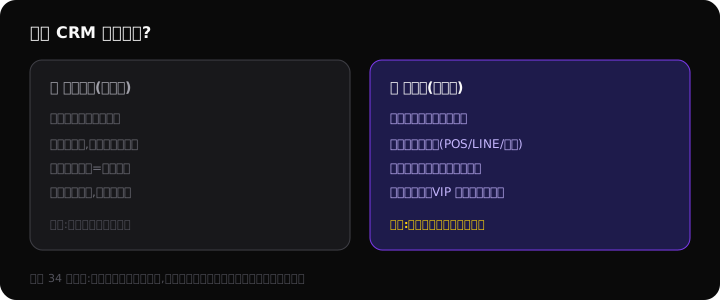
The fix is not "require staff to enter data carefully." That approach fails 100% of the time. People don't keep doing things that don't benefit them. The fix is automating the input: POS orders flow in automatically, LINE conversations get filed automatically, website forms write in automatically. People only add judgment. They don't serve as typists. Once you get here, the CRM has "the complete facts" for the first time. And this is the final fix for the data-gap problem I described in "How many people can you manage a company with on Excel?".
The 3-minute self-diagnosis: which problem does your CRM have
The one-line version: is there an automatically generated "who to follow up with" list every day? Yes = your CRM is alive. No = ask three more questions:
- Is your most-used feature "looking things up"? → Cause one. Start with a single feature: churn alerts.
- Are more than half the system's features ones you've never opened? → Cause two. Consider downgrading to a tool that's just enough. The money you save is profit.
- Do your orders, conversations, and leads flow into the system automatically? → Cause three. Connect the data sources first, then talk about features.
If all three apply, my honest advice: stop optimizing the system you have. Tearing it down and starting over is cheaper than saving it.
FAQ
Q: How much should a small business budget for a CRM? Figure out the use first, then the money. If all you need is follow-up reminders plus customer segmentation, a tool costing a few hundred to a few thousand NT dollars a month is enough. What loses you money isn't the monthly fee. It's buying a system that costs over NT$10,000 a month and using 10% of it. Use something cheap to get the process running smoothly, then upgrade when real needs show up.
Q: Should CRM and ERP be implemented together? Most small businesses do CRM first, ERP second. CRM fixes money on the customer side (repeat purchases, churn, follow-up). ERP fixes money on the operations side (inventory, cost, process). Plug whichever side is leaking first. But when choosing, ask clearly whether the two can share data later. Otherwise you're digging a second data silo. "Standard ERP vs. AI ERP" has the full way to decide.
Q: What if employees just don't want to use the CRM? Don't fight human nature. Redesign the process. The real reason staff don't use it: "I do the typing, the boss gets the benefit." Automate the input (the fix for cause three), and staff are left with only actions that directly help their numbers, like reading reminders and following up. Adoption goes up on its own. In a CRM where input is forced, the data quality is always fake.
Is your CRM an asset or a decoration?
If you finished this and found all three causes apply to you, that's actually good news, because each one has a fix. The case library of 252+ projects has approaches from your industry. Or book a free 30-minute diagnostic. Just pick a time that works for you online, and I'll help you decide whether to switch systems, change how you use it, or connect your data sources first.