
“AI compute is so scarce right now, and we have the capital. Should we build our own data center, buy a batch of GPUs, and sell compute?”
Several owners have asked me some version of this lately. Some run manufacturing companies and already have factory space and power. Some are investors who see that compute is hot. The idea isn't impossible. But it is a completely different business from “helping a company implement AI.”
I'm Johnny Yang, founder of Brightstream Technology in Taiwan. I've led my team doing system implementation for seven years, across more than 252 projects in 32-plus industries. The sentence I say to owners most often is “don't do this.” Building a token data center is something a lot of people should stop and run the numbers on first.
My answer: a token data center is a business of selling compute. Whether it makes money depends on utilization, not on how good your GPUs are. What holds you back isn't the graphics cards. It's power and cooling. In Taiwan, a large data center also has to get past Taipower, the state utility, first. Until you have stable, contracted customer usage, a small or mid-sized company should not build its own. Rent or colocate first.
What kind of business is a token data center?
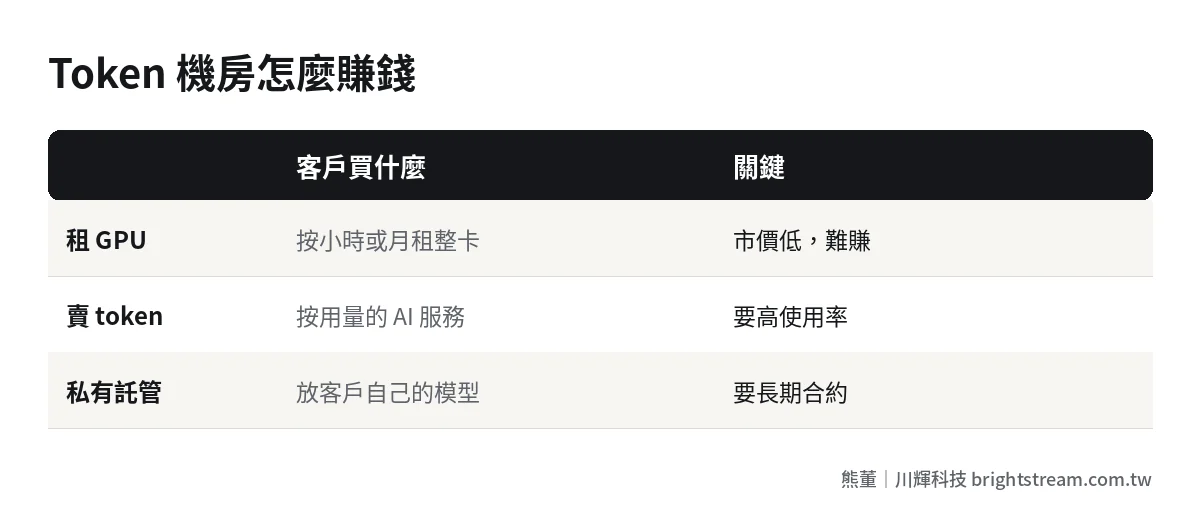
Put simply: buy GPUs, run models, sell compute. There are three common ways to sell it:
| How you sell | What the customer buys | Market price reference |
|---|---|---|
| GPU rental | A whole card, by the hour or by the month | H100 single-card spot price about US$2.5 to 3.5 per hour (ClusterBid) |
| Selling tokens | AI services billed by usage | NVIDIA claims DGX B300 running DeepSeek-R1 costs about US$0.24 per million tokens (NVIDIA, vendor figure) |
| Private hosting | Customers put their own models in your data center | By contract |
Taiwan already has GPU rental competitors. According to GPUtw's roundup, an RTX 4090 goes for about NT$13 to NT$23 per hour, and an RTX 5090 for about NT$24 to NT$32. That means the moment you enter, you are competing on price with existing cloud and rental providers.
Why does utilization decide whether you survive?
First, the intuition, which I'll grant: GPUs are scarce, prices are high, so it looks like buying them means making money.
What you actually have to calculate is this: one card's total annual cost, spread across every hour, and what you need to charge per hour to break even. Per ClusterBid's estimate, one H100 costs about US$31,860 to 38,000 a year in total. At full load you need to charge US$3.65 to 4.34 per hour to break even. At 70% utilization, you need US$5.21 to 6.20. To be clear, some of the math in that estimate doesn't add up, so treat it only as an order-of-magnitude reference.
Compare that with the market price above, US$2.5 to 3.5, and the conclusion is clear: renting out GPUs alone rarely makes money. It makes money when utilization is high and you have long-term contracts. According to Inflect citing McKinsey, owning current-generation GPUs and placing them in a colocation facility can cost 40% to 70% less than renting, once utilization passes about 70%.
So get the order right: customers first, then the data center. Not the data center first, then go looking for customers.
How much power does one AI rack need?
This is the number that shocks most people the first time they run it.
| Equipment | Power per rack | Cooling |
|---|---|---|
| L40S | 30 to 40 kW | Air |
| H100/H200 | Air-cooled 40 to 60 kW; liquid-cooled 80 to 120 kW | Air or liquid |
| B200 | 60 to 150 kW | Mainly liquid |
| GB200/GB300 NVL72 | GB200 about 120 kW; GB300 about 135 to 142 kW | Liquid required |
| Next-gen Vera Rubin | Over 200 kW; Rubin Ultra up to 600 kW | Liquid |
Sources: Inflect, DatacenterScope.
For comparison: a typical air-cooled data center in Taiwan usually tops out at 5 to 10 kW of cooling per rack (Mani International). One GB300 rack draws as much power as a dozen to two dozen conventional racks. That's why ordinary data centers can't hold AI equipment.
What five things do you have to handle to build one?
Power. Racks above 100 kW need three-phase 415V or 480V supply. For production inference services, dual power feeds are now standard, and circuits need 20% headroom. AI power draw can suddenly swing by 30% to 60%, and the electrical system has to absorb that.
Cooling. In 2026 the default is direct-to-chip liquid cooling; immersion cooling can go above 200 kW. Liquid-cooled facilities run a PUE (power usage effectiveness) of about 1.10 to 1.20, air-cooled about 1.40 to 1.60. These are Inflect's own estimates.
Floor loading. One NVL72 rack weighs about 1.4 to 1.5 metric tons, around 1,875 kg per square meter. A typical raised floor handles about 1,000 kg (Moduledge). In an old factory building, check first whether the floor can take it.
Network. GPUs need 400G to 800G high-speed links between them, using InfiniBand or Ethernet designed specifically for AI.
Software and billing. Run models with vLLM or SGLang, and NVIDIA Dynamo across multiple machines. To sell tokens you also need a gateway that handles keys, quotas, and usage billing. LiteLLM, for example, has these functions.
How much does one cost, and how long does it take?
| Item | Figure |
|---|---|
| Building and infrastructure | About US$10.7 million per MW (2025), projected US$11.3 million (2026) |
| AI data center (incl. liquid cooling etc.) | US$20 million or more per MW |
| Substation | 24 to 36 months |
| Large transformer lead time | 18 to 24 months |
| Conventional build | 18 to 24 months; modular AI data center 3 to 9 months |
Sources: Moduledge citing JLL, ClusterBid. These are US market figures. Actual construction costs in Taiwan need a separate quote.
The GPUs are a separate line item: an 8-GPU H200 server runs about US$320,000 to US$420,000, and one GB300 NVL72 rack about US$3 million to US$6.5 million. Details are in what hardware to buy for on-prem AI.
Taiwan's power supply and regulatory limits
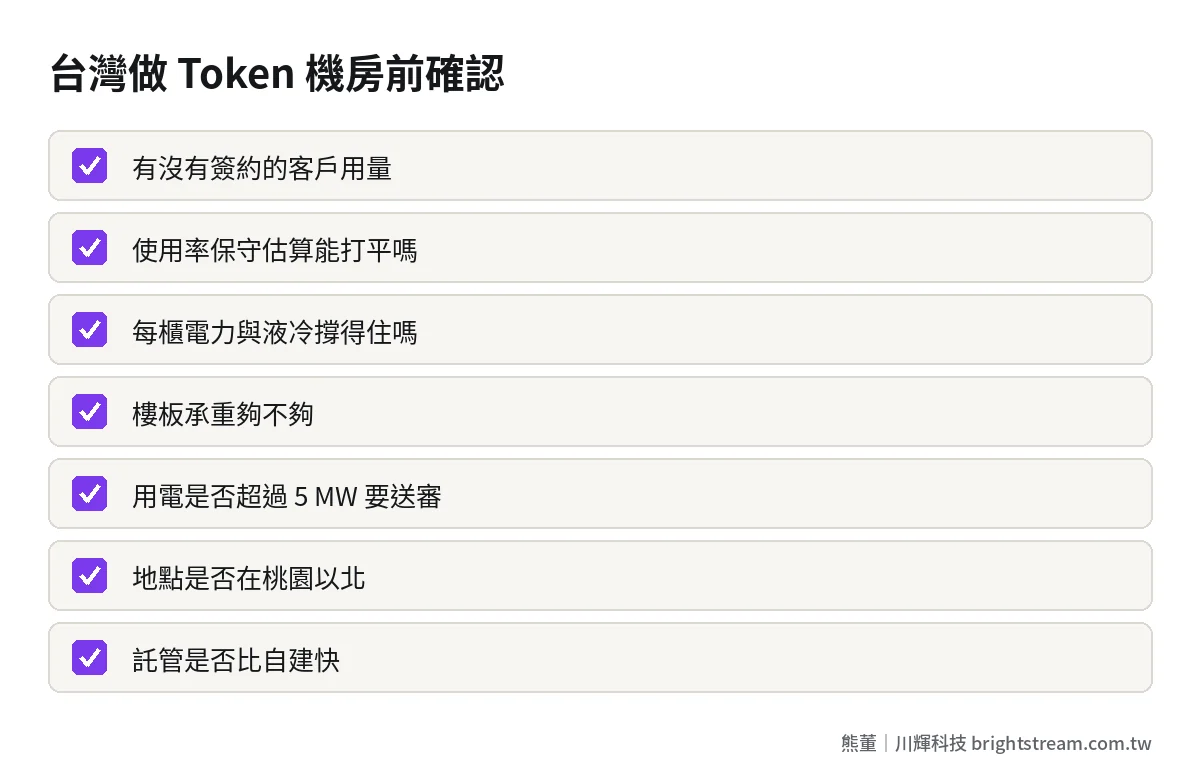
In Taiwan, the biggest barrier to building a large AI data center is whether Taipower will give you power.
| Rule | What it says |
|---|---|
| 5 MW and above requires review | Hyperscale and colocation data centers drawing 5 MW or more must submit an energy-use pre-planning review before construction; Taipower supply approval comes first; review takes about 3 to 6 months |
| PUE cap | 1.3 for hyperscale, 1.4 for colocation; effective November 5, 2025, applies only to new builds or expansions after that date |
| North of Taoyuan | Since 2024, Taipower no longer approves power for data centers over 5 MW north of Taoyuan |
| Conditional easing in 2026 | Taoyuan or Keelung can negotiate if they plan a dedicated AI data center zone near a power plant; power supply, industrial benefit, and energy efficiency are still reviewed; New Taipei and Taipei are not included |
Sources: Economic Daily News, United Daily News, China Times.
If you don't want to build your own, Taiwan has liquid-cooled colocation options. According to CIO's report, Chief Telecom offers water-cooled racks at 80 to 150 kW each, supporting GB200/GB300, with floors rated at 2,000 kg per square meter. They claim you can be up and running within two weeks. Pricing is not public.
What should a small or mid-sized company do?
My advice is direct:
- First confirm you actually want to sell compute. If your company just wants to use AI internally, that's an on-prem AI implementation. You don't need a data center. One workstation or server is enough.
- Talk hardware only after you have contracted customer usage. For example, your own SaaS product needs it, or an enterprise customer has signed a volume contract.
- Colocate first. Don't build. Under 5 MW, find a colocation facility with liquid cooling. It's much faster than building your own, and you skip the power supply review.
- Get the utilization math right. Calculate the break-even price using a conservative utilization rate, then compare it with the market price. If the numbers don't work, don't do it.
For the difference between on-prem AI and a token data center, and how to choose between cloud and on-prem, read open-source models or cloud LLMs and what on-prem AI can't do.
Frequently asked questions
Can you make money building an AI data center to sell compute?
Yes, but only if utilization is high and you have long-term contracts. Estimates show an H100 at 70% utilization needs to charge about US$5 to US$6 per hour to break even, while the market price is about US$2.5 to US$3.5. Renting out GPUs alone rarely pays.
Can a regular data center hold AI servers?
Mostly no. A typical air-cooled data center in Taiwan tops out at about 5 to 10 kW of cooling per rack. AI racks range from 30 kW to over 140 kW, and the newest generation requires liquid cooling. You need a dedicated liquid-cooled colocation facility.
What are the restrictions on building a data center in Taiwan?
Above 5 MW you must first get Taipower's supply approval and submit for review, and PUE is capped. North of Taoyuan, power above 5 MW is generally not approved. From 2026, dedicated zones near power plants get a conditional exception.
Does a small or mid-sized company need its own data center to use AI?
No. For internal AI use, one workstation or server in your office or a small server room is enough. You only need data-center-grade facilities if you're selling compute externally at volume, and even then, colocate first.
Closing: customers first, then the data center
A token data center is a capital-heavy business that lives or dies on utilization. The biggest barriers are power and cooling, and in Taiwan you also have to pass a power supply review. Until you have stable customer usage, don't do this.
If what you actually want is for your company to use AI internally, you don't need to build a data center. Take a look at how we do AI system development first. If you really are evaluating a compute business, bring your customer usage numbers and I'll run the math with you once.