“They gave me three clients' phone numbers. I called all of them. Every one said the vendor was great and easy to work with.” I've heard this many times, and usually only after the project has gone wrong: go-live pushed back again and again, one additional quotation after another. Looking back, the owner realizes those calls didn't actually find out anything.
I'm Johnny Yang, founder of Brightstream Technology in Taiwan. I've led teams building systems for seven years, handled more than 252 projects across more than 32 industries, and taken over systems other vendors couldn't finish. The owners behind those projects almost all did their homework at the start and called the vendor's past clients. The problem wasn't whether they called. It was what they asked.
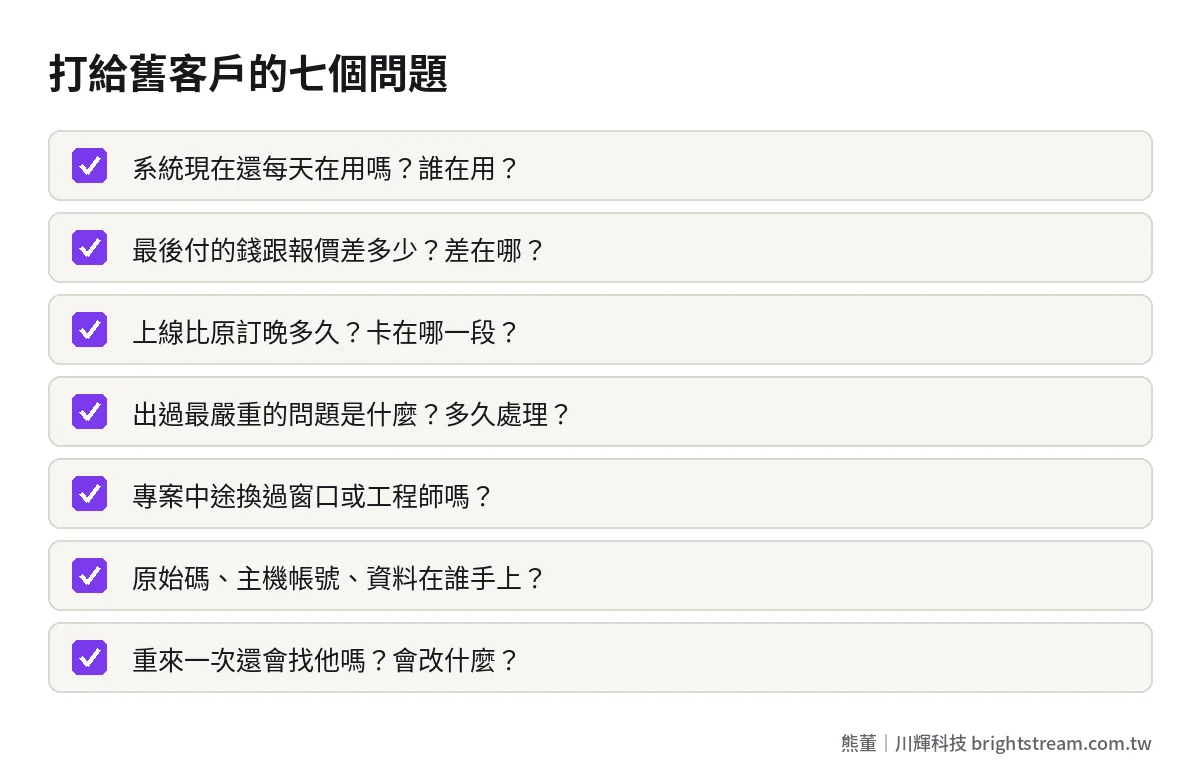
My answer: when you call a vendor's past clients, the goal isn't to confirm “is this vendor good.” It's to find out three things — whether anyone still uses the system after go-live, how far the money and time ended up from what was promised, and how the vendor handled things when something went wrong. Ask seven specific questions: who uses the system every day now, how much the final bill differed from the quotation, how much later than planned it went live, what the worst problem was, whether people were swapped out mid-project, who holds the source code and server accounts, and whether they'd hire this vendor again. Don't just listen for good or bad. Listen for how specific the answer is: a reference who can give numbers and describe what happened counts. One who only says “it was all great” and “very cooperative” means you didn't really ask anything.
“The vendor's references are always hand-picked” — so the questions matter more
Start by admitting your instinct is right: the reference clients a vendor gives you are the ones they're most confident about. No vendor volunteers a client they fought with. So many owners decide calling is pointless and skip it.
That's only half right. A hand-picked client won't tell you “this vendor is terrible.” But a hand-picked client will still answer factual questions honestly. Ask “are they good?” and they'll say yes. Ask “how much did the final payment differ from the quotation?” and they'll usually give you a number and a reason. Satisfied clients have add-ons and delays too. They just felt it was handled well enough in the end.
So the point is: ask about facts, not feelings. Feelings get filtered and softened by politeness. Facts are harder to dress up. You're not after their rating. You want to see, through their experience, what you might run into over the next six months.
Before the call: how to ask for references and who to talk to
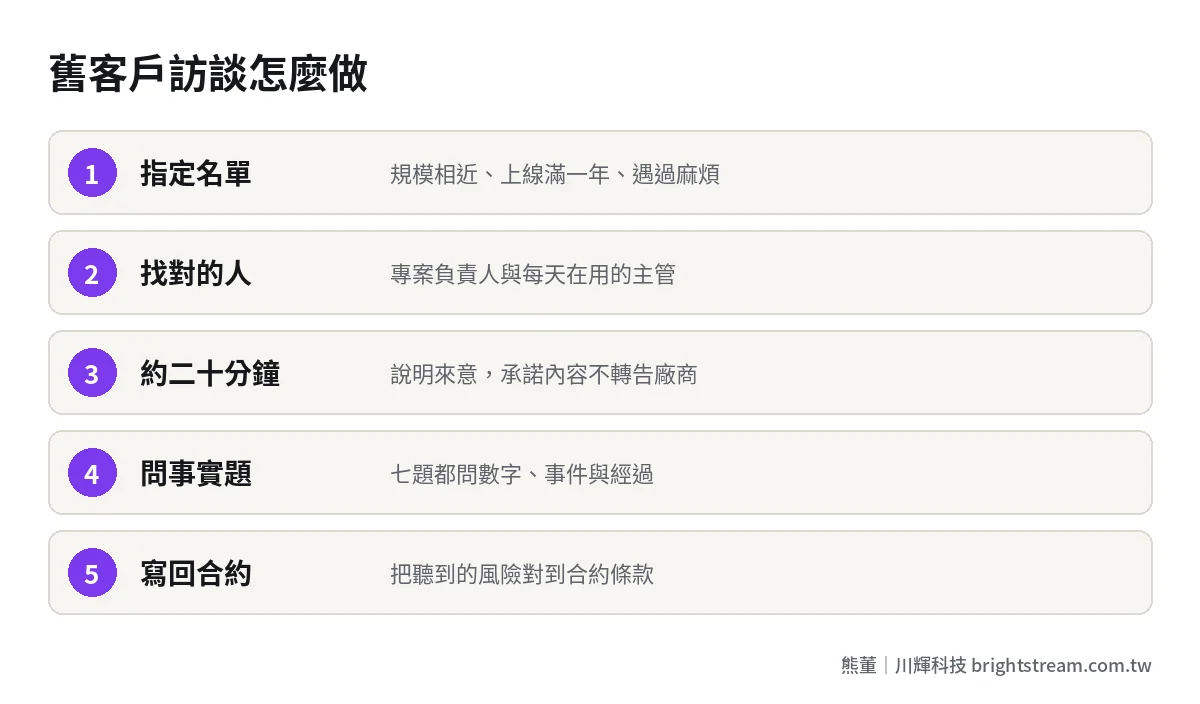
When you ask for references, set conditions first
Don't just say “give me a few clients' phone numbers.” Set conditions: similar size and industry to us, live for more than a year, and one that ran into trouble mid-project. The last condition matters most. A vendor willing to give you a client who “had problems but got them resolved” is usually more reliable than one who only offers perfect cases.
Talk to the right people, not just the owner
The owner sees the results. The project lead knows the process. Ideally talk to two people: the manager who ran the project, who knows how the add-ons and delays happened, and someone who uses the system every day, who knows whether it's actually usable now.
Book twenty minutes and say why up front
Explain that you're evaluating the same vendor, want to learn from their experience, and won't pass anything they say back to the vendor. Twenty minutes is enough. Longer puts pressure on them. Briefly describe your company's size and the system you want built beforehand, so they can answer from your angle.
Seven questions, and what to listen for in each
1. Is the system still used every day? By whom?
This is the first question and the most important one. A signed acceptance doesn't mean anyone uses the system. Brightstream worked with a printing company that had spent over NT$1,000,000 on two ERP systems nobody could get working. The third one, built around their own workflow, took employee adoption from under 20% to over 90%. The first two were presumably signed off at acceptance too.
What to listen for: can they name which departments, and which daily tasks, run in the system. If the answer is “mainly accounting uses it” or “sales still prefers Excel,” you know the system is only half alive. I wrote up that printing company's story in more detail in Over NT$1,000,000 on two ERP systems nobody used.
One more detail worth asking: how do new hires learn the system? If it's “a coworker shows them and they get it,” the system fits how the floor actually works. If every new hire needs the vendor to come in and run a training session, the system is still too hard for the people using it, and adoption will slide sooner or later.
2. How much did the final payment differ from the quotation? Where did the difference come from?
Add-ons are common. They're not a warning sign. The warning sign is when the client can't explain why there were add-ons, or agreed to them under “no extra money, no work.”
What to listen for: was the add-on because “we decided to do more later,” or because “the vendor didn't estimate it at the start”? Was each add-on confirmed in writing first? Many owners won't share the total price, so ask “roughly what percentage more” and “how many add-ons.” For how to set add-on rules in the contract ahead of time, see 12 questions to ask before signing an ERP contract.
3. How much later than planned did it go live? Where did it get stuck?
Late go-lives are common too. What you need to hear is where it got stuck. Stuck because the client was cleaning up its own data is completely different from stuck because the vendor couldn't build it. The first you can prepare for in advance. The second will happen again, to you.
Another key point: when it was delayed, did the vendor say so on their own, or only when asked? A vendor that proactively says “this part will be late, here's why, here's what we need from you” has a delay you can manage. One that waits until right before go-live to say it won't be done has turned the delay into a risk.
4. What was the worst problem? How fast did the vendor respond, and how did they handle it?
Any system that's been in use for a while has had problems. If they say “we've never had a problem,” either they barely use it or they don't want to say. Ask it another way: “When was the last time you asked them to fix something?”
What to listen for: how long from reporting to a response, how long from response to fix, and whether the vendor explained the cause afterward. You can also ask: did the same problem come back? A problem that keeps recurring means each fix only patched the surface and never found the real cause. What you hear on this question is what your maintenance period will really look like.
5. Did the contact person or engineers change mid-project?
The presales person who talked to you, the project manager, the engineers writing the code — swapping people mid-project isn't rare in this industry. The change itself isn't necessarily the problem. The problem is whether the handover was done properly.
What to listen for: after the change, did the new person make the client explain the requirements again from scratch? If so, this vendor's knowledge lives in people, not in documents.
6. Who holds the source code, server accounts, and data?
Many clients can't answer this one. Not being able to answer is the answer: it means nobody discussed it at signing and nobody is managing it now.
I took over a project for a medical aesthetics brand whose previous vendor had been building a system for several years and never launched it. The first thing we did was get everything back, then decide what to do with it. In the end we rebuilt it. Asking this before signing would have saved a lot of wasted effort. For how to write source code and licensing into the contract, see Who owns the code in a custom-built system.
7. If you did it again, would you hire them? What would you change?
The last question gets the most honest answer. “Yes” is good, but the valuable part is the second half: “Yes, but I'd write out the reporting requirements first.” “Yes, but the contract needs response times.” Whatever they'd change is exactly what you should fix before you sign.
How to hear warning signs in the answers: a comparison table
For the same question, how they answer matters more than what they say. Keep a copy of this table next to the phone.
| Question | Reassuring answer | Answer to watch out for |
|---|---|---|
| Who uses it now | Can name the departments and the daily tasks | “Mainly accounting uses it” “Everyone's still getting used to it” |
| How much more it cost | Can say how many add-ons, why, and that they were in writing first | “We added quite a bit later, but it all got done anyway” |
| How late | Can say where it got stuck and how it was resolved | “It kept slipping and we never knew why” |
| Worst problem | Can describe the incident, the response time, and the explanation afterward | “Never had a problem” or “You wait a long time when you call them” |
| Did people change | Yes, but with a handover, no need to re-explain requirements | “Three different contacts, had to re-explain every time” |
| Source code and accounts | Knows where they are and whose name they're under | “Not sure” “The vendor handles all that” |
| Would hire again | Yes, and can say what they'd change | A long pause, or just “it's okay” |
Look at the table and you'll see the reassuring answers share one thing: they're specific. Numbers, incidents, what happened in what order. If someone can describe it, it really happened and was really dealt with. The answers to watch out for are all vague. Vague doesn't necessarily mean the vendor is bad, but it means this client didn't see clearly either, so you can't treat their “it's okay” as a guarantee.
Beyond the list: find the client the vendor didn't give you
The vendor's reference list is a starting point, not the whole picture. If someone among your peers, friends, or suppliers has used the same vendor, that call is often worth more than the ones the vendor gave you, because nobody picked them.
How to find them: ask your accountant, friends in your trade association, and suppliers you deal with often whether anyone has recently gone through a system implementation and which vendor they used. You can also ask the vendor directly: “Which other clients have you done in our industry?” They may not be able to share contact details, but how much detail they can give tells you whether they've really done the work or just heard about it.
Also, watch how the vendor reacts when you say “I'd like to call your clients.” One who readily says “Sure, I'll put you in touch” is usually confident in their delivery. One who starts making excuses, or will only give you a single name, deserves a follow-up: why? That reaction is itself part of the evaluation.
On the day of each call, write down the answer to every question. Don't rely on memory. After two or three calls, put them side by side and the vendor's pattern becomes obvious: stuck at the same stage every time, add-ons for the same thing every time. Those are what you need to deal with before signing.
After the calls, write the risks back into the contract
Past-client interviews aren't for giving the vendor a score. They're for finding what you need to guard against first. After the calls, map every risk you heard to a clause in the contract:
- Heard about many add-ons: define the scope clearly in the contract, quote a fixed price against a written feature list, and require written confirmation before any add-on.
- Heard problems take a long time to get fixed: specify severity levels and resolution deadlines in the contract.
- Heard requirements had to be re-explained after a staff change: require documentation as a deliverable, and agree that any change of key personnel must be announced in advance.
- Heard nobody knows where the source code is: specify ownership and handover of the source code, server accounts, and data in the contract.
- Heard employees aren't using it: add actual-usage items to the acceptance criteria. Building the features doesn't count as done.
I suggest evaluating a vendor in three stages: the demo, to judge whether the system can do the job; past-client calls, to see how they've worked before; the contract, to see what they're willing to commit to. I've laid out what to ask during a demo in What to look for in an ERP vendor demo. If you haven't started looking yet and want to screen out the wrong kind of vendor first, see What kind of vendor to hire for ERP implementation. Only when a vendor passes all three stages have they really passed.
You can also look at case studies from similar businesses and run the same seven questions through your head: if you called these clients, how would they answer?
Frequently asked questions
What if the vendor won't share past clients' contact details?
Some clients don't want to be bothered, and the vendor has to ask their permission first. That's normal. Give them some time to arrange it. But if the vendor can't produce a single client willing to talk, and can't give case details you can verify, treat that as part of the evaluation.
Is a past client from a different industry still useful?
Factual questions work across industries. How add-ons happened, how problems were handled, who holds the source code — none of that depends on the industry. A client in a similar industry can also tell you whether the vendor understands your workflow. Talking to both is best.
How many past clients should I call per vendor?
At least two or three. With just one, you might be hearing an exception. By the third, you can usually see the vendor's fixed pattern, like getting stuck at the same stage every time, or adding charges for the same thing every time.
Can I just ask past clients how much they spent?
You can ask, but many people won't share the total. Ask instead “roughly what percentage over the quotation did it end up” and “how many add-ons, and why.” People are more willing to answer those, and the two answers are more useful for evaluating the vendor anyway.
Conclusion: only calls about facts are worth making
Calling past clients isn't about hearing nice things. It's about seeing what you might run into over the next six months. Ask about facts, listen for specifics, write the risks back into the contract. A twenty-minute call could be the best-value twenty minutes of the whole project.
If you've finished the calls, have a quotation in hand, and are getting ready for the next step, look at how ERP implementation works and check what needs confirming at each stage.