

At the start of the month, the owner wants to know how much the group actually made last month and how much stock is still sitting in the warehouses. The accountants at three companies each send over an Excel file, and the owner's assistant pastes them together and adds them up. Revenue comes out noticeably higher than the owner's gut feeling, and inventory is higher than makes sense. Two days of digging later, they find it: goods Company A sold to Company B were booked as revenue once at A, then again when B sold them on. That batch happened to be in transit at month-end, so it sat on both companies' books.
I'm Johnny Yang, founder of Brightstream Technology in Taiwan. I've led teams building systems for seven years, across more than 252 projects in over 32 industries. I've been a business owner myself, in six industries, and I know that feeling well: every company has its reports, and you still can't see the whole picture.
The short answer: when a group of companies needs to be seen as one, the hard part isn't building a report. It's three things. First, master data has to be unified: customers, suppliers, item numbers, and chart of accounts across companies must map to the same set of codes. Second, intercompany transactions have to be tagged and eliminated at consolidation, or revenue and inventory will be double-counted. Third, closing schedules have to line up; if each company closes on a different day, the totals don't describe the same point in time. There are three ways to do it: Excel consolidation, a consolidation layer on top of each company's own system, or one system running multiple companies. Which one depends on how many companies you have, how much they trade with each other, and how often the owner needs to look. One more distinction: a management-level consolidated view for the owner's decisions and formal consolidated financial statements for outside parties are two different things. The latter must follow accounting standards and is handled by your accountant.
Why are the numbers always wrong when you add up several companies' reports?
Many owners think consolidation means adding things up. Adding up is only correct in one case: the companies have no dealings with each other at all, and their customers and products don't overlap. In reality, a group that sets up several companies almost always has them trading with each other.
There are four common sources of double counting:
- Intercompany sales. The manufacturing company sells goods to the trading company, which sells them to the customer. The same goods count as revenue at both companies, and as cost at both. Add them up and both revenue and cost are inflated, and gross margin looks distorted too.
- Intercompany services and charges. The parent charges subsidiaries management fees, rent, and loan interest. One side books income, the other books expense. Added together, both sides stay in, and it looks like the group did more business.
- Inventory in transit or on consignment. Goods have left Company A's warehouse but Company B hasn't received them, or goods are held in the other company's warehouse. They may be on both companies' books, or on neither.
- One customer, several codes. The same customer deals with three companies in the group, and shows up in three systems under three different codes, spelled three ways. You want to know how much business this customer did with the group in a year, and you simply can't add it up.
So the summed number isn't "a bit off." It's systematically too high, and you don't know by how much. Making decisions on that number is more dangerous than having no number at all.
"Each company just manages itself well" is a reasonable idea
First, a word in defense of this idea. Separate legal entities should be managed separately. Each company has its own invoices, its own taxes, its own bank accounts, its own accountant. Regulation and practice require that. Many owners split into several companies in the first place to keep responsibilities clear.
If each company manages itself well, day-to-day operations really are fine. Each company's accountant can close the books and file taxes, and each company's warehouse staff knows its own stock.
But the real problem is this: the owner makes decisions at the group level, not the single-company level. Which company should move cash to which, whether stock in one warehouse can cover another company's order, who the group's biggest customers actually are, whether overall gross margin is improving or slipping. No single company's report can answer any of these.
So the point isn't to merge several companies into one and manage them that way. It's to keep each one well managed and add a view that sees them together. For that view to be right, each company's data has to match up first.
Three things to unify before you look at them together
| What to unify | What happens if you don't | Suggested owner |
|---|---|---|
| Customer and supplier master data | One customer counted as three; you can't tell who your big customers are | Sales manager and accounting, jointly |
| Item master data | The same product has different names at each company; inventory won't add up | Purchasing or product lead |
| Chart of accounts mapping | Each company splits accounts differently; cost structures can't be compared | Finance manager |
| Intercompany transaction tagging | Revenue and inventory double-counted | Tagged by whoever raises the document, checked by accounting at month-end |
| Closing date and closing schedule | The totals aren't from the same point in time | Finance manager sets the rules; every company follows them |
The hardest item in this table is item master data. Group companies were often founded at different times and numbered their items independently: some use supplier part numbers, some use their own running numbers. Unifying them doesn't have to mean renumbering everything. You can build a mapping table so every item number maps to one shared group code. For how to clean up item numbers, see What messy part numbers cost you: cleaning up product master data.
The chart of accounts doesn't have to be identical at every company either. Each company can keep its own accounts, as long as each one maps to a set of group management accounts, and you look at consolidated figures through those. The finance manager has to decide this. Don't leave it to the system vendor to guess.
Three approaches: Excel consolidation, a consolidation layer, one system for multiple companies
Only once master data and rules are set do you choose an approach. None of the three is more advanced than the others. The difference is how many companies you have, how often they trade with each other, and how often you want to look.
Approach 1: Excel consolidation. Each company submits a report in a standard format, the finance manager combines them and eliminates intercompany transactions by hand. Fits groups with few companies, little intercompany trade, and a once-a-month view being enough. Lowest cost, but it depends heavily on that one finance manager. When they take leave or quit, the whole thing stops.
Approach 2: Each company's own system plus a consolidation layer. Each company keeps its current system. A separate consolidation layer pulls each company's data automatically every day or week, converts it to group codes using the mapping tables, tags and eliminates intercompany transactions, and produces the dashboard the owner needs. Fits groups where each company already has a system, doesn't want to replace them all, but wants to see the whole picture more often.
Approach 3: One system running multiple companies. All companies use the same system, each with its own separate set of books and shared master data. When one company raises an intercompany document, the system automatically creates the matching document on the other side. Fits groups with heavy intercompany trade that were planning to replace their systems anyway. Highest level of integration, but the largest implementation scope; every company has to change how it works.
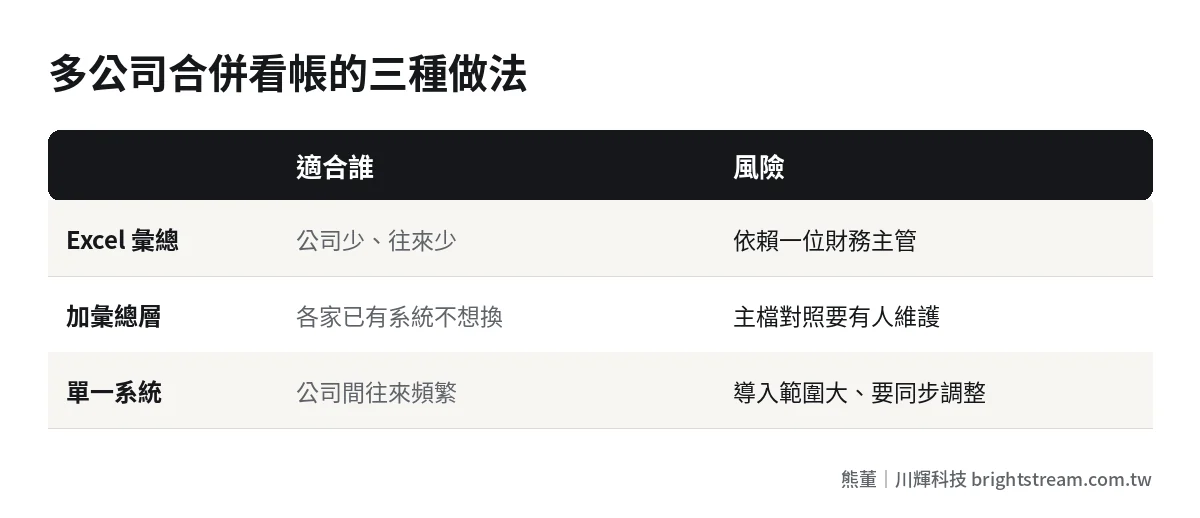
In my experience, most groups should start with Approach 2. The reason is practical: getting every company to switch systems at once carries a lot of risk and resistance, but Excel consolidation alone rarely survives staff turnover. Start with master data mapping and intercompany tagging so the owner can see the whole picture every week. When a company's old system genuinely needs replacing, bring it into the shared system then, one at a time. On which data should be shared and which should stay separate, The hardest part of managing multiple clinics isn't the system is about clinics, but the logic is exactly the same.
Roughly what does it cost and how long does it take?
The three approaches differ a lot in cost, but the most time-consuming part is the same for all of them: master data mapping. Whichever you choose, someone has to map each company's customers, items, and accounts to group codes first. The cleaner this step, the faster everything after it.
At Brightstream, system implementation starts at NT$300,000 and is quoted to spec. We write the scope into a written feature list first, then quote a fixed price, with payment in stages; each payment is collected only after the agreed result is running. A consolidation layer is usually a smaller scope, because it doesn't touch each company's daily operations. One system for multiple companies is a full implementation, and scope and timeline have to be estimated from each company's processes. Either way, I recommend a trial run on one company and one month of data first, confirming the numbers after elimination reconcile, before rolling out to all of them.
How should intercompany transactions be handled so nothing is double-counted?
This is the core of the whole thing and deserves its own section. The principle fits in one sentence: intercompany transactions must be tagged the moment they happen, not hunted down at month-end.
In practice there are three steps:
- Tag at document creation. When Company A issues a delivery note or invoice to Company B, the system must know B is a group company and automatically tag the document as intercompany. The simplest way is to set up each group company as a specific category in the customer and supplier master data.
- Reconcile at month-end. What A's books show as "sold to B" must equal what B's books show as "bought from A." When they don't match, it's usually goods in transit, returns, or invoice timing differences. Track down the cause line by line.
- Eliminate at consolidation. When looking at group figures, remove the tagged intercompany revenue and cost, and net off intercompany receivables and payables against each other. What remains is the business the group actually did with the outside world.
Inventory follows the same logic. If moving goods within the group just means storing them in a different warehouse, with no sale involved, it should be a transfer, not a sale. I wrote about how to record transfers and in-transit stock in Managing inventory across multiple warehouses: recording transfers, in-transit, and loaned stock. With multiple companies you just swap "warehouse" for "company," with an extra layer of invoicing and tax handling.
A reminder: what I'm describing here is a management view for the owner's decisions. If your group needs to issue formal consolidated financial statements, the scope of eliminations and the recognition methods are governed by accounting standards, and that goes to your accountant. A well-built system can make your accountant's work much faster, but it can't replace your accountant's judgment.
What should the group view the owner sees every month look like?
Once the approach is chosen, what the owner actually needs is a screen they can read. I suggest the group view include at least the items below, and each one should let you drill down to see which company, which customer, and which product is driving it.

- Group revenue and gross margin after eliminating intercompany transactions, and the change from last month.
- Each company's contribution to group gross margin, not just its own revenue.
- The group's top customers, ranked by combined business across all companies.
- Total group inventory including in-transit, expandable by product and warehouse.
- Each company's cash position and receipts and payments for the coming weeks, so you can see which company is short and which has surplus.
- A list of intercompany reconciliation differences. The fewer differences, the more you can trust the numbers above.
Cash position is the one many owners feel most. Inside a group, it's common for one company to sit on plenty of cash while another is borrowing and paying interest. Seeing the whole picture gives you a basis for moving money around. For how to build a cash flow forecast, see How to build a cash flow forecast: seeing funding gaps 13 weeks ahead.
Finally, count the time cost. Say a group has three companies, and the finance manager spends three days a month manually combining, eliminating, and reconciling. That's thirty-plus working days a year, and the owner has to wait until mid-month to see last month's full picture. That time cost, plus the risk of deciding on wrong numbers, is your baseline for deciding whether to build a consolidation layer.
Frequently asked questions
Do multiple companies have to use the same ERP?
Not necessarily. If there's little intercompany trade, each company can keep its current system and add a consolidation layer on top. The owner sees the whole picture, and the risk is lower. If intercompany sales are frequent and documents need to generate each other, one system running multiple companies saves effort, but the implementation scope is larger, and you need to assess whether every company can adjust at the same time.
What's the difference between a management consolidated report and formal consolidated financial statements?
A management consolidated view is for the owner's decisions. What matters is that it's timely, can be drilled into, and uses consistent rules. Formal consolidated financial statements must be prepared under accounting standards and handled by your accountant, with rules governing elimination and recognition. A system can feed both from the same clean data, but judgments on the formal statements still belong to your accountant.
Do transfers of goods within the group need an invoice?
It depends on whether it's a sale between separate legal entities. Moving goods between different companies is usually a sale, which involves invoices and tax. Moving goods between warehouses within the same company is a transfer. Confirm how to handle it with your accountant, then design the system's documents around the confirmed rules.
Subsidiaries use different charts of accounts. Can they still be viewed together?
Yes. Each company keeps its own accounts, and you build a mapping table that maps each account to shared group management accounts, then view the consolidated figures through those. The finance manager must maintain the mapping table and update it whenever accounts are added. Otherwise the consolidated numbers will slowly drift.
To add up, the numbers have to match first
Viewing a group's numbers together was never about how good the report looks. It's about master data that matches, intercompany transactions that are tagged, and closing schedules that line up. Get those three right, and Excel, a consolidation layer, or a single system will all show you the real picture.
If you're waiting several days every month to see the group's numbers and aren't sure where to start cleaning things up, bring your current reports and talk to me. Book a free 30-minute diagnostic, and I'll start by finding where things are stuck.